








ESG enters the financial era: The turning point from GRI to ISSB for executives to read
1 Introduction: The Paradigm Shift of Sustainable Development Reports
Over the past two decades, when it comes to the proposition of ESG (Environmental, Social and Governance) disclosure, the main discourse framework for corporate executives was established by the Global Reporting Initiative (GRI). We have witnessed countless enterprises using the GRI standards to prove their social responsibility to the outside world. The core of the GRI guidelines lies in "Impact Materiality", which adopts an "inside-out" perspective and requires enterprises to elaborate on the economic, environmental and human impacts of their business activities, regardless of whether these impacts immediately cause direct fluctuations in the financial situation of the enterprises. For communities, employees, non-governmental organizations and government regulatory agencies, GRI reports are the key ledger for measuring the level of an enterprise's qualification as a social citizen.
However, as the pricing mechanisms for climate risks and sustainable development risks in global capital markets have become increasingly mature, the demands of investors have fundamentally shifted. They no longer merely want to understand what enterprises have done to the external world; they are more eager to know how changes in the external world - such as the implementation of carbon pricing policies, the frequent occurrence of extreme weather, and the intensification of resource scarcity - will inversely affect the asset value, cash flow, and long-term survival ability of enterprises. This "from the outside to the inside" risk perspective has given rise to the International Sustainability Standards Board (ISSB) and its issued IFRS Sustainability Disclosure Standards.
This evolution marks the formation of a "double materiality" closed loop. Within this framework, enterprises must handle two types of disclosure tasks simultaneously: one is to explain the environmental and social impact of the enterprise to a diverse range of stakeholders through GRI; the other is to explain to professional investors how these impacts and the hidden risks behind them will be transformed into financial risks through ISSB. If GRI showcases the social image of the enterprise, then ISSB is redefining the valuation logic of the enterprise. As the decision-making layer of the enterprise, understanding the dialectical relationship between these two sets of standards is not only for avoiding compliance risks, but also for occupying a strategic high ground in the global wave of green capital flows.
2 IFRS S1 "General Requirements for Sustainability-related Financial Information Disclosure" - The cornerstone of the ISSB standards
As a general standard within the ISSB framework, IFRS S1 sets out the overall requirements for sustainable-related financial information disclosure. Its core lies in establishing a "four-pillar" structure: governance, strategy, risk management, and indicators and targets. S1 requires enterprises to disclose the substantive impacts of sustainable-related risks and opportunities on their short-term, medium-term, and long-term business models, strategies, and financial plans. It can be understood that S1 provides a unified "grammar rules" for the disclosure of all sustainable issues, while subsequent specialized standards (such as S2) are the "vocabulary" for specific issues. Without the frameworkal constraints of S1, any specialized disclosure would be difficult to form a systematic and comparable information loop.
3 IFRS S2 "Climate-related Disclosures" - The Legal Checklist for Responding to Climate Change
Climate change is widely recognized as the most significant and urgent systemic risk facing the current capital market. Therefore, while releasing the general guidelines, the ISSB also prioritized the publication of the specific climate-related standards - IFRS S2.
The legal logic of risk classification: Physical risks and transformation risks
The IFRS S2 requires entities to identify and disclose two specific types of climate risks. As an international lawyer, I believe this classification holds significant defensive disclosure significance:
• Physical Risks: These are classified as acute (such as damage to assets caused by frequent hurricanes and floods) and chronic (such as rising sea levels and global warming leading to a continuous decline in agricultural output). For manufacturing or resource-based enterprises with a large amount of fixed assets and complex supply chains, physical risks imply potential business interruption risks and accelerated depreciation of assets.
• Transition Risks: This is a high-risk area for legal compliance. It encompasses policy changes (such as the EU's Carbon Border Adjustment Mechanism CBAM), legal proceedings (such as securities lawsuits due to failure to fulfill climate disclosure obligations), technological substitution (such as the shift from fossil energy to renewable energy), and changes in market reputation. Any misjudgment of the path of low-carbon transition could lead to the "asset stranded" of enterprises.
The mandatory nature of carbon accounting and the challenges of Scope 3
The most notable requirement of IFRS S2 is the mandatory disclosure of greenhouse gas emissions. According to the standard, entities must disclose their total absolute greenhouse gas emissions and classify them into scope 1, scope 2, and scope 3 in accordance with the standards of the "Greenhouse Gas Accounting System" (GHG Protocol). It should be noted that the ISSB standards themselves do not have mandatory legal effect; their binding force depends on the adoption of legislation or regulation by each jurisdiction.
For senior executives, the disclosure of Scope 3 is a major area of legal risk. Scope 3 encompasses all indirect emissions within the enterprise's value chain, including upstream emissions from the purchase of goods and emissions during the use of sold products. According to the guidance of S2, although enterprises can obtain certain transitional exemptions in the initial years of application, in the long run, a comprehensive understanding of Scope 3 is essential. The legal risk lies in that if enterprises lack an effective mechanism for collecting data on supply chain emissions and merely rely on inaccurate industry averages for estimation, they may face legal accountability for "misleading statements" in the future.
Climate Resilience: Scenario Analysis as a Survival Test
The IFRS S2 standard requires companies to assess their climate resilience through scenario analysis. This means that executives must publicly acknowledge in their reports whether the company's business model remains robust under the stringent carbon reduction path of a "1.5°C global temperature rise limit", or in the extreme physical risk scenario of "above 3°C".
From a legal perspective, scenario analysis is not a prediction of the future, but rather a stress test. The process of disclosing scenario analysis can demonstrate to the market that the management has fully fulfilled its fiduciary responsibility in risk identification, thereby establishing a strong compliance firewall in the event of enterprise losses caused by unforeseen events.
4. Interoperability and Compliance Simplification: The Collaborative Path of GRI and ISSB
When confronted with two parallel international standards, what enterprises are most concerned about is the waste of resources caused by duplicate reporting. As lawyers, they have always emphasized the efficiency of "collecting once and using multiple times" in terms of compliance.
Practical Application of the "Building Block" Approach
The IFRS Foundation and the GRI organization have reached a substantive cooperation. The so-called "building block" approach means that enterprises can use the ISSB standards as the common underlying framework (global baseline) for the global capital market. On this basis, they can superimpose GRI and other standards according to the needs of stakeholders to achieve more extensive disclosure of social issues. This structure not only ensures the global comparability of information disclosure but also retains the flexibility of enterprises to respond to different regulatory requirements.
Currently, both parties have jointly released an interoperability guideline. For instance, in terms of the measurement of greenhouse gas emissions, the ISSB has fully adopted the "Greenhouse Gas Accounting System", which is consistent with the accounting logic of GRI. If an enterprise has already established a complete energy and emission monitoring system based on the GRI standards, then the underlying data generated by it, after appropriate financial significance filtering, can be directly used for ISSB reports. This data-level "recognition" significantly reduces the marginal cost of cross-border compliance.
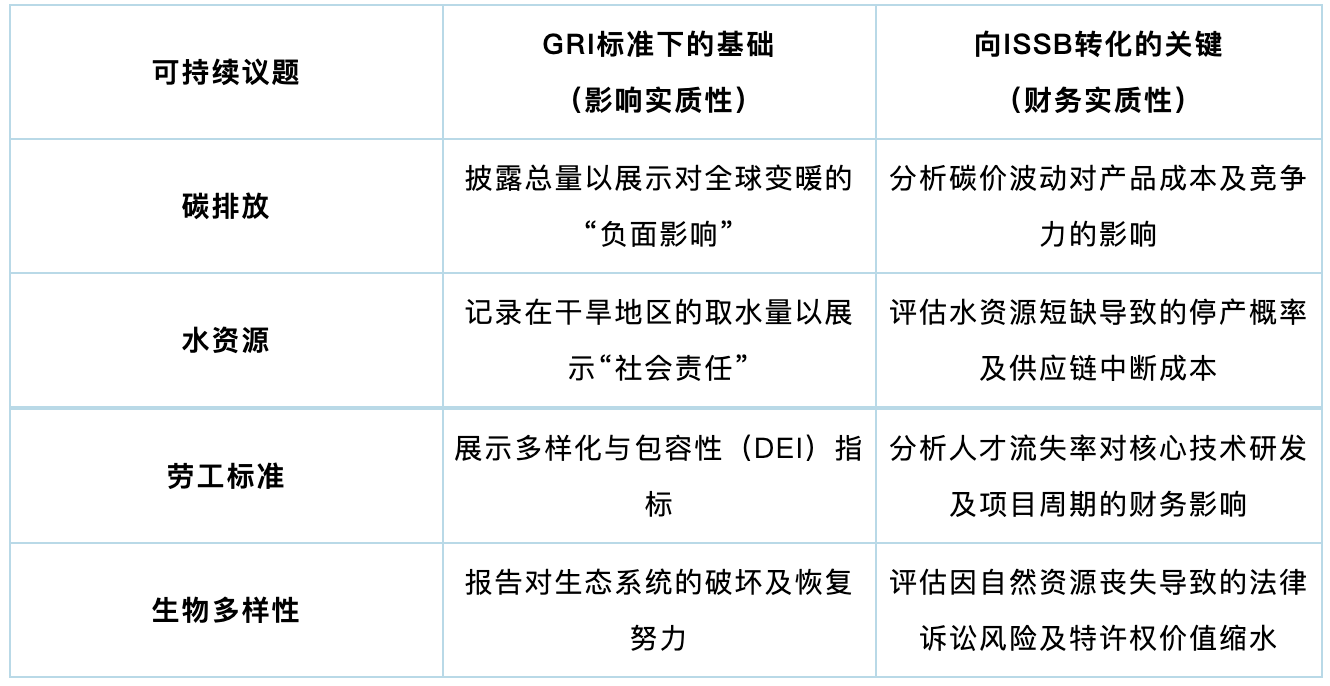
To facilitate enterprises' understanding of how to convert their existing GRI disclosures into substantive financial information in line with the requirements of the ISSB, the following table provides examples of key issues for comparison:
5 Global Regulatory Landscape and China's Practice
The globalization pace of the ISSB standards has far exceeded market expectations. Currently, more than 36 jurisdictions around the world have explicitly stated that they will adopt or are currently consulting on adopting the ISSB standards.
The compulsory trend in the international market
• EU (European Union): Although the EU has its own ESRS standards, through continuous consultations with ISSB on core climate indicators, it has achieved extremely high alignment.
• UK and Hong Kong: These two major financial centers have announced that their local regulatory requirements will fully align with the ISSB. This means that Chinese companies listed in these regions will have to upgrade their disclosure standards from "referencing GRI" to "strictly following ISSB" in the coming years.
• The United States: Although the climate disclosure rules of the U.S. Securities and Exchange Commission (SEC) have experienced some setbacks at the judicial level, its substantive requirements in climate risk management, scenario analysis, and greenhouse gas disclosure are still highly consistent with those of the ISSB, serving as a crucial compliance reference for multinational enterprises that cannot be ignored.
The path of sustainable disclosure in China
As an important strategic partner of ISSB, the Ministry of Finance of our country is unwaveringly promoting a sustainable disclosure framework with Chinese characteristics.
In November 2024, the Ministry of Finance issued the "Corporate Sustainable Disclosure Standards - Basic Guidelines (Trial)", officially establishing the framework for our country's standards: structurally, it follows the four pillars of the ISSB; in terms of content, it should not only comply with the common rules of the international capital market, but also reflect the particularities of China in local issues such as rural revitalization and common prosperity.
Subsequently, in December 2025, the Ministry of Finance released "Corporate Sustainable Disclosure Standard No. 1 - Climate (Trial)". This standard extensively drew on IFRS S2 in terms of technical indicators, requiring enterprises to disclose physical risks, transition risks, and greenhouse gas emissions. This marks that the ESG reports of Chinese enterprises are moving from "descriptive" to "quantitative financial-oriented".
For Chinese executives, this means the arrival of a "double compliance era". Enterprises need to pay attention to the regulatory timetable in China (which usually follows the principle of voluntary compliance first, then mandatory compliance; large enterprises first, then small and medium-sized enterprises), and also keep a close eye on the legal changes in their overseas investment and financing locations (such as Hong Kong, London, and Luxembourg).
6. Directors' Responsibilities and Compliance Risk Prevention: The Advice of Senior Lawyers
In legal practice, the implementation of ISSB standards will transform sustainable disclosure from an "optional moral embellishment" to a "mandatory legal statement". This will profoundly affect the underlying logic of corporate governance.
"Greenwashing": From Reputation Damage to Legal Violation
With the widespread adoption of ISSB standards, securities regulatory agencies (such as the SEC in the United States, the FCA in the United Kingdom, and the CSRC in China) will have more standardized criteria to assess whether companies are engaging in false promotion in the sustainable development field.
The so-called "greenwashing" has a legal nature of misleading statements. If a company claims in its IFRS S2 report that it has an ambitious net-zero transformation plan, but in its financial data there is no support for these plans in terms of R&D investment or capitalization schemes, this "inconsistent behavior" will become direct evidence for investors to initiate securities class-action lawsuits.
The directors' duty of diligence and the consistency of disclosure
Under the traditional legal framework, directors bear the ultimate responsibility for the authenticity of financial reports. The ISSB standards require that sustainable financial information be released in the same report as the financial statements, which actually strengthens the supervisory obligations of directors.
The directors now need to question: Why are the asset impairment assumptions in the financial statements not reflected in the climate risks described in the sustainability reports? This "data conflict" not only leads to audit failure but is also more likely to trigger legal accountability. We suggest that enterprises incorporate sustainability disclosure into the regular review scope of the board's audit and risk committee, and establish a linkage review mechanism for disclosure and financial reporting.
The "safe harbor" regime and the protection of forward-looking statements
Due to the fact that ISSB disclosures contain a large amount of future projections, the legal "protection of forward-looking information" has become extremely important.
When corporate executives release such information, they must ensure that their disclosure process adheres to the principles of "honesty and good faith" and "having reasonable basis". Lawyers suggest that in the report, a prominent note should be made: This information is based on specific scientific assumptions and policy scenarios, and the actual results may vary significantly due to various unpredictable factors. This structured statement can establish a "safe harbor" firewall for the company, reducing liability disputes caused by inaccurate predictions.
7 Conclusion: From Compliance-driven to Strategic Value Creation Business Wisdom
The arrival of ISSB standards represents a reconfiguration of the core values of enterprises. As executives, one should not merely view it as yet another cumbersome compliance cost. From both legal and financial perspectives, high-quality sustainable disclosure is a new carrier of enterprise credit.
When enterprises can clearly and accurately demonstrate how they manage climate risks, how they reduce emissions in their value chains, and how they ensure business resilience in accordance with the requirements of the ISSB, they are essentially reducing the uncertainty premium for investors. This transparency can directly translate into lower financing costs, more stable stock performance, and stronger bargaining power in the global green value chain.
From GRI's "social impact" to ISSB's "financial risk", this is not merely a change of standards, but rather a progression of thinking. In this era of uncertainty, only those enterprises that can perceive sustainable risks and quantify them in financial terms can win the long-term trust of the capital market. It is recommended that all enterprise executives immediately initiate the benchmarking work of internal audits and data systems, and use this standard of ISSB to re-examine and enhance the long-term growth potential and risk defense boundaries of the enterprises.


