








Engineering Subcontracting Legal Red Lines and Compliance Operations Practice (Part 1)
Abstract:
Project subcontracting is a common business model in the construction industry.However,legal red lines such as“no subcontracting of the main structure”,“prohibition of total subcontracting”,and“prohibition of re-subcontracting”are often ambiguously addressed in practice,leading to numerous disputes over contract validity.This article systematically reviews the legal framework governing project subcontracting and distills five core legal principles.It defines the method for identifying the“main structure”.The article further analyzes four forms of disguised subcontracting and the courts’“substance-over-form”piercing doctrine.Based on the Construction Law,Article 793 of the Civil Code,and the Judicial Interpretation(I)of the Supreme People's Court on the Trial of Construction Contract Disputes(Fa Shi[2020]No.25),and drawing on typical Supreme Court precedents,this article provides a judicially verifiable compliance framework for general contractors.
Keywords:
Project Subcontracting;Main Structure;Disguised Subcontracting;Piercing Doctrine;Compliance Framework;Empirical Study
Introduction and Preface
Introduction:
The previous chapter addressed three core questions: What red lines does the law set for project subcontracting? How do courts determine "the main structure"? Can disguised subcontracting be penetrated? This chapter starts from the regulatory framework, then defines the main structure based on three-dimensional standards, reveals the common patterns of disguised subcontracting through four forms, and builds a defense system with a five-element evidence chain.
Introduction:
Transferring some non-core and non-essential tasks to specialized subcontracting units is a common business model in the construction industry. However, routine operations do not necessarily imply low-risk operations.
From the perspective of judicial practice, the field of engineering subcontracting has concentrated the most frequent legal disputes in construction project contract disputes.
The core issue of this article: Where exactly is the legal boundary for project subcontracting? How can the main contractor establish a compliant and sustainable subcontracting system within the legal framework?
1
The legal regulatory framework for project subcontracting
I. The hierarchical structure of current legal norms
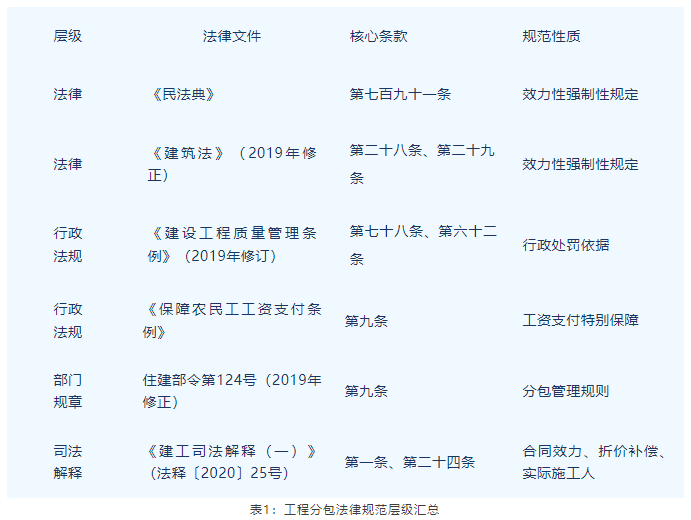
The legal norms for project subcontracting present a four-level structure of "law → administrative regulations → departmental rules → judicial interpretations", with each level complementing one another and jointly forming a compliance framework.
(1) Legal Aspects
The "Building Law of the People's Republic of China (Amended in 2019)" (hereinafter referred to as the "Building Law") serves as the top-level legal basis for project subcontracting, establishing the principles of "prohibition of subcontracting", "the main structure shall not be subcontracted", and "prohibition of further subcontracting".
Article 28: "It is prohibited for the contracting entity to transfer all the construction projects it has contracted to others. It is also prohibited for the contracting entity to break down all the construction projects it has contracted and then subcontract them to others under the guise of subcontracting."
Article 29: "The general contractor of construction projects may subcontract part of the contracted project to a qualified subcontractor; however, except for the subcontracting agreed upon in the general contract, it must be approved by the construction unit. For construction general contracting, the construction of the main structure of the building must be carried out by the general contractor itself." …… It is prohibited for the general contracting unit to subcontract the project to units that do not meet the corresponding qualification requirements. It is also prohibited for the subcontracting unit to further subcontract the project it has contracted.
2. Article 791 of the Civil Code of the People's Republic of China (hereinafter referred to as the "Civil Code")
The second paragraph of this article stipulates: "The contractor shall not transfer all the construction projects contracted by him to a third party, nor shall he disintegrate all the construction projects contracted by him and then subcontract them to a third party under the guise of subcontracting."
Article 3 stipulates: "The contractor is prohibited from subcontracting the project to units that do not meet the corresponding qualification requirements. Subcontractors are also prohibited from further subcontracting the projects they have contracted. The construction of the main structure of the project must be completed by the contractor itself."
(II) At the level of administrative regulations
Article 78 of the "Regulations on Quality Management of Construction Projects" (revised in 2019) provides a definitive definition of illegal subcontracting, clearly stipulating that "the general contractor subcontracting the construction of the main structure of the project to other entities" is regarded as an illegal subcontracting act, and Article 62 specifies the corresponding administrative penalties.
2. "Regulations on Ensuring Payment of Wages to Migrant Workers" (Order No. 724 of the State Council, implemented in 2020)
This regulation has established a special guarantee mechanism for the payment of migrant workers' wages. Article 30 stipulates that if the subcontractor delays in paying the wages of migrant workers, the general contractor shall first make the payment and then legally claim the payment from the subcontractor. This regulation obliges the general contractor to assume the legal obligation of making the advance payment for the wages of migrant workers, and it has become an important part of the compliance of the general contractor's subcontract management.
(III) At the level of departmental regulations
"Measures for the Management of Subcontracting in Construction of Housing Buildings and Municipal Infrastructure Projects" (Order No. 124 of the Ministry of Housing and Urban-Rural Development, revised in 2014 and again in 2019, hereinafter referred to as "Order No. 124 of the Ministry of Housing and Urban-Rural Development")
Article 9 stipulates: "For professional project subcontracting, unless otherwise stipulated in the construction general contracting contract, it must be approved by the construction unit. The contractor of the professional subcontracting project must complete the contracted project independently. Labor operation subcontracting is agreed upon by the labor operation contractor and the labor operation contractor through a labor contract. The labor operation contractor must complete the contracted tasks independently."
(4) Judicial Interpretation Level
"Interpretation of the Supreme People's Court on Applicable Legal Issues in Cases Involving Construction Project Contract Disputes (First Edition)" (Judicial Interpretation No. 25 of 2020, coming into effect on January 1, 2021, hereinafter referred to as "Construction Project Law Interpretation (First Edition)")
The first point is clearly stated: "If a contractor enters into a construction contract with others through subcontracting or illegal division of construction projects, such a contract shall be deemed invalid in accordance with Article 153(1) of the Civil Code and Articles 791(2) and (3) of the Civil Code." This point also stipulates that if any of the following circumstances exist, the contract shall be deemed invalid in accordance with Article 153(1) of the Civil Code: (1) The contractor does not possess the qualification for construction enterprises or exceeds the qualification level; (2) The actual contractor without qualification borrows the name of a qualified construction enterprise; (3) The construction project must undergo bidding but is not bid or the bid is invalid.
Article 43 establishes the rules for actual contractors to break through the contractual relative nature: "If an actual contractor sues the subcontractor or the illegal subcontractor as the defendant, the people's court shall accept the case in accordance with the law. If an actual contractor claims rights against the employer, the people's court shall add the subcontractor or the illegal subcontractor as a third party in this case. After ascertaining the amount of the construction project price that the employer owes to the subcontractor or the illegal subcontractor, the court shall order the employer to be responsible for the actual contractor within the scope of the unpaid construction project price."
II. Five Core Legal Principles
From the above regulations, five core legal principles that run through the entire field of project subcontracting can be extracted (see Table 2). The application scope of these principles varies: Principles 1 to 3 are mandatory provisions of effectivity, and violation will result in the invalidity of the contract; Principle 4 is a legal joint liability that cannot be excluded through contractual agreements; Principle 5 is a special rule.
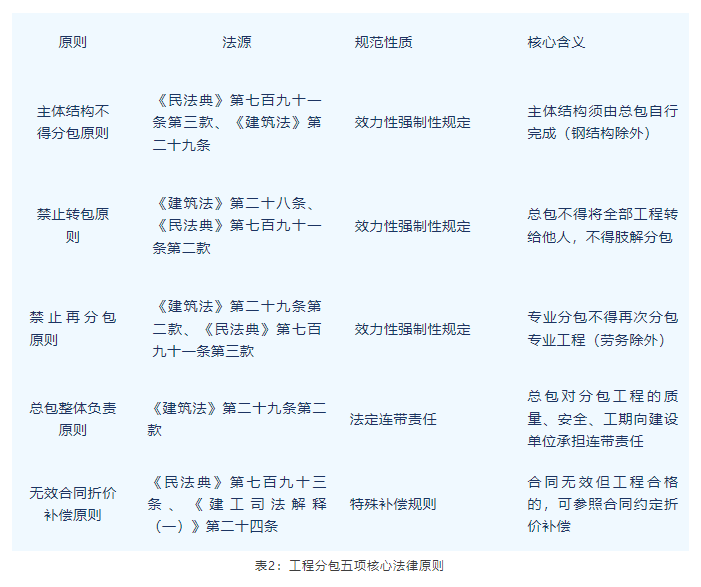
The phrase "excluding steel structures" is usually based on the industry practice that steel structure projects are highly specialized and are typically constructed by enterprises with specific qualifications. However, this exception does not mean that subcontracting can be done at will. The units accepting the subcontracting must possess the corresponding professional contracting qualifications.
2
The judicial determination of the "main structure"
one
The formulation of the problem
Article 29 of the "Building Law" prohibits subcontracting of the main structure. However, the law has never provided a closed definition for "main structure". This has led to continuous disputes in judicial practice.
two
Based on practical experience analysis
(1) Basis for Defining "Main Structure"
Since judicial cases usually do not provide specific explanations for the "main structure", the scope of the main structure should mainly be determined based on the national standards and industry norms for architectural design, construction and acceptance (such as "Unified Standard for Reliability Design of Building Structures", "Code for Quality Acceptance of Concrete Structure Construction" etc.) as well as relevant administrative regulations and departmental rules. These normative documents are the main technical basis and legal source for defining the specific content of the "main structure".
(2) Evidence Presentation Strategy
In cases involving illegal subcontracting, over-assignment or disputes over construction quality, if it is necessary to prove that a certain project belongs to the "main structure", corresponding engineering design drawings, construction records, technical appraisal reports, etc. should be prepared to demonstrate that this part of the project is a key component of the load-bearing system or the main force transmission system in terms of architectural mechanics and functions.
(3) When the court determines the main structure
Generally, the principle of "functional standards take precedence over location standards" is followed. That is, whether this part is responsible for the overall load-bearing and force transmission of the building, rather than merely considering its location.
Three
Practical operation suggestions
(1) Definition at the Contract Level
In the subcontract agreement, it is clearly stipulated: "The work under this contract does not include any main structure or critical tasks. The detailed list can be found in the attachment." The attachment should list the scope of the subcontract work (such as "filling wall masonry") in detail and indicate that "the above-mentioned work has been confirmed by the design and specifications and does not belong to the main structure."
(2) Preservation at the Evidence Level
Save the contents of the engineering design documents and the construction organization design regarding the classification of work, to prove that the subcontracted work is classified as "building decoration and renovation" "building mechanical and electrical installation" and other non-core specialties.
3
The disguised subcontracting form of the main project and the determination of penetration
one
Core legal principle: Substance trumps form
In practice, the general contracting unit tends to adopt forms such as "labor cooperation", "internal contracting", "joint venture", and "commissioned management", attempting to circumvent the legal prohibitions through such forms. The housing and urban-rural construction authorities and the courts, when determining the nature of the subcontracting, adhere to the principle of substantive over formalism - the contractual names on the surface (such as "labor subcontracting contract") do not determine the legal nature; the substantive rights and obligations arrangements are the basis for determination.
two
Four typical forms of disguised subcontracting
(1) Under the guise of "labor cooperation", they actually engaged in project subcontracting.
Surface structure: The general contractor signed a "Labor Subcontract Agreement" with the labor company, stipulating that "steelworkers, concrete workers" and other labor services would be provided.
Piercing the determination of key evidence and the determination outcome:
(1) The labor company actually supplies the main materials (such as steel bars, concrete, cables, etc.).
(2) The labor company actually provided large machinery (such as tower cranes and construction elevators);
(3) The general contractor does not assign project managers (project leader, technical supervisor, quality inspector, safety inspector) to the project.
(4) The payment will be calculated based on the project volume, rather than on the number of working days or hours.
If the subcontracted content involves the main structure, according to Article 29 of the "Construction Law", the contract is invalid; the general contractor shall bear joint liability for quality, safety and debts.
(2) Under the guise of "internal contracting", they actually engage in subcontracting or affiliation.
Surface structure: The general contractor signs a contract with the "internal project department" or "internal staff" to entrust the construction work to this "internal unit", and the general contractor will receive management fees.
Piercing the determination of key evidence and the determination outcome:
(1) The so-called "internal employees" have no social security records, no formal appointments, and do not receive salaries.
(2) The funds, risks and management are completely independent of the general contractor.
(3) In fact, the contractor was organizing the construction on their own.
According to Article 1, Paragraph 2 of the "Construction Industry Judicial Interpretation (I)", subcontracting and illegal subcontracting contracts are deemed invalid in accordance with Article 153, Paragraph 1 of the Civil Code and Article 791, Paragraphs 2 and 3 of the Civil Code. The general contractor shall bear joint liability for the quality, safety and external debts of the subcontracted projects.
(3) Under the guise of a " consortium ", engaging in actual subcontracting activities
Surface structure: The consortium agreement stipulates "joint cooperation", and the general contractor collects the management fee.
Piercing the determination of key evidence and determination consequences: (1) One party of the consortium does not participate in the bidding, does not bear any risks, and only receives management fees; (2) There is no genuine consortium agreement or the agreement is obviously false. It should be determined as subcontracting and the winning bid is invalid.
(4) Under the guise of "entrusted management", actual subcontracting is carried out.
Surface structure: The general contractor entrusts a third party for "on-site management", and the third party charges a management fee.
Piercing the determination of key evidence and determination consequences: (1) The third party is actually responsible for procurement, subcontracting, and settlement; (2) The general contractor only receives management fees and does not participate in on-site management; (3) The on-site personnel are recruited and managed by the third party.
Three
"Five-element" evidence chain
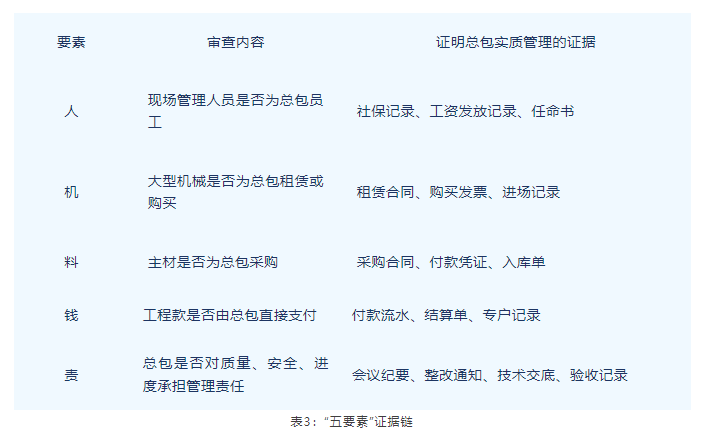
Based on the enforcement and judicial practices in the construction industry, the core elements of "substantive management" can be summarized into five aspects: the affiliation of management personnel, the affiliation of large machinery, the affiliation of main material procurement, the payment path of project funds, and the affiliation of quality management responsibilities. Complete management traces are an effective way to prove that the general contractor did not constitute illegal subcontracting.
4
Summary
The first part focuses on the legal regulatory framework for engineering subcontracting, the judicial recognition standards for the main structure, and the rules for identifying disguised subcontracting. The core conclusions can be summarized as follows:
First, under the current legal framework, "the main structure shall not be subcontracted" is a mandatory and binding regulation. The general contractor must accurately understand the judicial determination logic of "functional standards taking precedence over local standards", and make dual preparations at the contract and evidence levels.
Second, the law enforcement agencies and courts adhere to the principle of "substance over form" when dealing with disguised subcontracting. Even if the "labor cooperation", "internal contracting", "joint venture", or "commissioned management" is legally valid on the surface, if it actually shifts the main construction obligations of the project, it will be regarded as illegal subcontracting or subcontracting.
Thirdly, the "five-element" (person, machine, material, money, responsibility) evidence chain is the practical operational framework for the general contractor to prove that they dge in illegal subcontracting. The more complete and in-depth the management traces are, the lower the risk of being identified. id not enga
However, in practice, the risks related to subcontracting compliance go far beyond this - the following section will analyze the boundaries between labor subcontracting and subcontracting, the determination of "major subcontracting", the absolute prohibition of further subcontracting of professional subcontracting, as well as the settlement handling after the invalidity of the violation contract. These issues constitute another set of frequently disputed focal points. The legal regulations for these issues are more detailed, and the enforcement and judicial judgment standards are also more specific.


