








Engineering Subcontracting Legal Red Lines and Compliance Operations Practice (Part 2)
Preface
The distinction between subcontracting, illegal subcontracting and subcontracting is one of the most controversial issues in the field of project subcontracting in practice. This article clarifies the criteria for identifying subcontracting, illegal subcontracting and subcontracting, summarizes the criteria for identifying "subcontracting under the guise of labor subcontracting but actually being subcontracting", systematically analyzes the elements and legal consequences of "large-scale subcontracting", and clearly stipulates the prohibition rules for subcontracting units to further subcontract. It also answers three core questions: Where is the boundary between labor subcontracting and subcontracting? How is "large-scale subcontracting" identified? Can the subcontracting unit further subcontract?
01
Subcontracting, illegal subcontracting and subcontracting beyond authorization
I. Distinction between subcontracting, illegal subcontracting and subcontracting for transfer
In the field of construction projects, subcontracting, illegal subcontracting and subcontracting are three core legal acts that must be strictly distinguished from each other. The criteria for their identification and the legal consequences are completely different. Accurate identification is the foundation of compliance management and risk prevention.
(1)
Conceptual hierarchy and relationships
Subcontracting: This is a broader concept, referring to the situation where the contractor entrusts part of the work within the contracted project to a third party for completion. Subcontracting per se is not necessarily illegal.
Legal subcontracting: Subcontracting that is conducted under legal conditions, mainly including professional engineering subcontracting and labor operation subcontracting.
Illegal subcontracting: Subcontracting activities that violate mandatory provisions of laws and administrative regulations are a form of illegal subcontracting behavior.
Subcontracting: It refers to the situation where the contracting entity transfers all of the projects it has contracted to others, or breaks down the projects and subcontracts them to others under the guise of subcontracting, while itself not fulfilling any contractual obligations or management responsibilities.
The relationship among the three can be illustrated as follows:
(II)
Specific criteria for distinguishing between subcontracting, illegal subcontracting and subcontracting for transfer
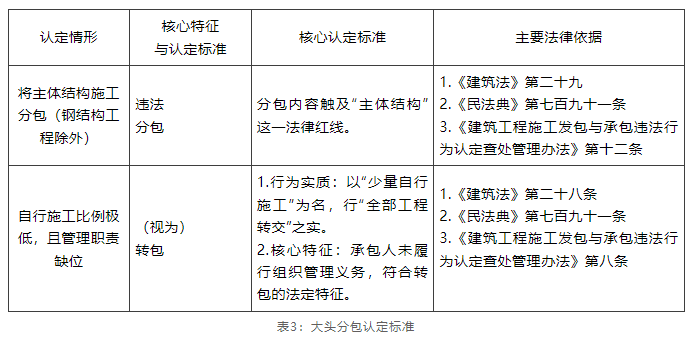
The distinctions among legal subcontracting, illegal subcontracting, and illegal subcontracting of the project are reflected in aspects such as the qualifications of the parties involved, the scope of subcontracting, management responsibilities, the legality of the procedures, the project scope, and the actual performance of management duties. The specific summary is as follows:
two The criteria for identifying "what is labeled as labor subcontracting but is actually a form of subcontracting"
(1)
Legal provisions
"Where no project management organization is established at the construction site and no corresponding personnel are dispatched, and no organization and management of the construction activities of the project is carried out, it shall be regarded as a subcontracting behavior", that is, the failure of the contracting unit to fulfill its management responsibilities is an important criterion for identifying "a project named as labor subcontracting but actually a subcontracting". (See Article 13 of the "Measures for the Management of Subcontracting in Housing Construction and Municipal Infrastructure Projects")
"It is prohibited for the contracting entity to transfer all the construction projects it has contracted to others, and it is also prohibited for the contracting entity to break down all the construction projects it has contracted and then subcontract them to others under the guise of subcontracting." (See Article 28 of the "Construction Law of the People's Republic of China (2019 Amendment)", Article 791 of the "Civil Code of the People's Republic of China", and Article 13 of the "Measures for the Division of Construction Projects in Housing Construction and Municipal Infrastructure Construction")
The essential characteristics of subcontracting include:
The contracting party shall not entrust all the project to others, nor shall it divide the entire contracted project and then subcontract it to others under the guise of a subcontract.
2. The contracting party does not actually manage the construction activities.
3. The undertaking unit fails to fulfill the contractual obligations.
(II)
Analysis of Criteria for Determination
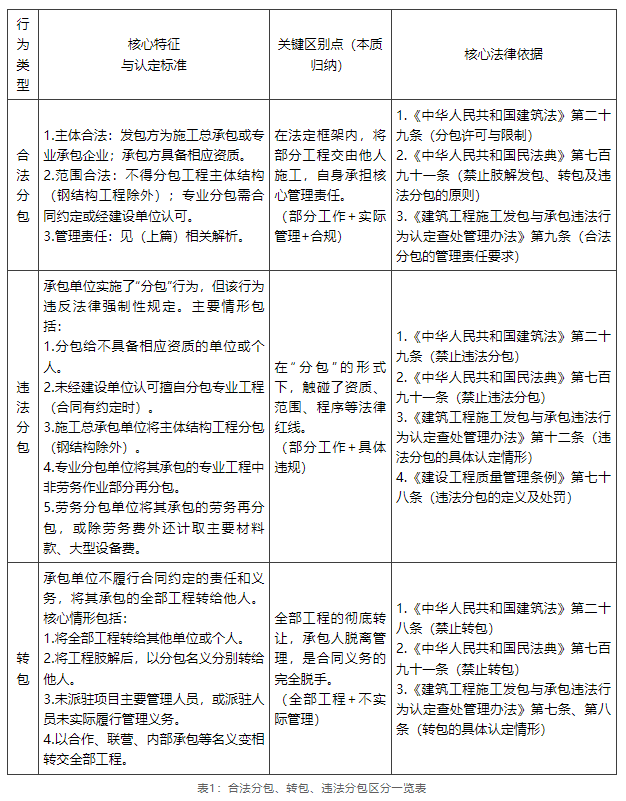
The criteria for identifying "what is labeled as labor subcontracting but is actually a form of subcontracting" mainly include the following aspects:
1. Project scope: Does the contracting party transfer all the contracted projects to others or divide them into parts and then subcontract them to others under the guise of subcontracting?
2. Management Responsibility: Has the contracting unit established a project management organization at the construction site and dispatched management personnel? Has it organized and managed the construction activities? (See the previous section)
3. Contract performance: Did the contracting unit fulfill the management, organization, technical, and quality responsibilities stipulated in the contract, or did it merely hold a nominal position while collecting management fees or other charges, and handing over the entire actual construction work to others?
The criteria for identifying "what is labeled as subcontracting but is actually a form of subcontracting" are summarized as follows:
When the court examines the essence of the general contracting management, it will take into account the contractual provisions, the implementation process and the evidence chain, penetrate through the contract name and superficial form, pay attention to the actual provision and management of main materials, large machinery and management personnel, as well as the settlement method of remuneration, and determine the substantive nature of the contract. If the labor party actually undertakes the procurement of main materials, the leasing of large machinery, and on-site management and settles according to the comprehensive unit price, it is usually regarded as subcontracting or engineering subcontracting, and the contract is invalid. It may also face administrative penalties, civil liabilities (such as quality responsibility, compensation liability, etc.) and other legal consequences.
III. Compliance Operation Suggestions
Compliant subcontracting operations are the key for construction enterprises to prevent legal risks such as "illegal subcontracting" and "transferring contracts". The compliance process is mainly based on "preliminary review - contract norms - process management - post-event traceability", highlighting the sequence and connection of risk prevention and control. The specific suggestions are as follows:
(1)
Pre-review stage
1. Clearly define the scope of subcontracting: It is essential to clearly stipulate that the subcontracting scope is limited to purely labor operations or specialized projects. It is strictly prohibited to subcontract all the contracted projects, the construction of the main structure (except for steel structure projects permitted by law), as well as the construction contents of the key and core technologies of the project.
2. Qualification Verification: Conduct a comprehensive review of the proposed subcontracting units' qualifications to ensure they possess legal and valid labor qualifications. Also, verify their business scope and qualification level, and resolutely prevent subcontracting to units without qualifications or those exceeding their qualification limits.
(II)
Contract Specification Section
1. Standardize contract terms: In the subcontracting contract, clearly define the management, organization, quality, safety and other responsibilities of the contracting unit, elaborate on management measures, prevent the contract terms from becoming formalistic and lacking content, and eliminate the phenomenon of nominal contracting.
2. Clearly prohibit illegal subcontracting: The contract must stipulate that the labor subcontractor shall not further subcontract the labor project it has contracted. Those who violate this rule shall bear the liability for breach of contract, and the supervision rights of the contracting unit shall also be agreed upon.
(III)
Process Management Phase
Carrying out actual management responsibilities: The contracting unit should establish a project management organization at the construction site, appoint project managers, technical directors and other key personnel to actually participate in and manage the entire construction process, and prevent situations where they merely hold the position without taking any action or allowing the labor teams to conduct construction on their own.
2. Strict on-site supervision: Conduct full-process supervision over the construction activities of the subcontracting units to ensure that they fulfill their responsibilities in accordance with the contract and promptly correct any violations on site.
(4)
Post-event traceability
Establish management records: The contracting unit should establish and keep project management ledgers, records of personnel on duty, management logs, meeting minutes, etc., in both written and electronic forms, to form a complete management loop, facilitating subsequent evidence presentation.
2. Regular self-inspection and rectification: Conduct regular self-examinations on the compliance of subcontract management, promptly rectify any identified issues, and prepare written reports.
(5)
Risk and Response
The key focus is on preventing the risk of "false subcontracting": If the contracting entity fails to fulfill its management responsibilities, if the labor subcontracting entity exceeds the scope of work, or if there is any further subcontracting, all of these situations may be regarded as illegal subcontracting or subcontracting, resulting in invalid contracts, administrative penalties, and associated liabilities such as payment of project funds.
2. Defense and Response by the Opponent: In case of a dispute, the opponent may assert that the contract is invalid or that the actual contractor requests direct payment of the project funds. The contracting unit should provide evidence such as management ledgers, on-site management records, and contract fulfillment records to prove that the operations were carried out in accordance with the law and regulations.
In conclusion, it is recommended to follow the main line of "preliminary review - contract norms - process management - post-event traceability" to gradually implement the compliance requirements for each link, and effectively prevent the legal risks of being identified as illegal subcontracting or subcontracting. In actual operation, management measures should be dynamically adjusted according to the actual situation of the project to ensure that the subcontracting is legal, compliant, and traceable.
02
The criteria for identifying "large-scale subcontracting" and its legal consequences
"Big-head subcontracting" is not a legal term; rather, it is a description used in practice for a situation where the general contractor undertakes too little work on its own. The subcontracting contract does not explicitly stipulate the subcontracting ratio, but in actual implementation, the work completed by the subcontractor far exceeds the portion completed by the general contractor itself. Is this situation illegal? How is it determined? What are the consequences?
I. Criteria for Determination
(1)
Two types of identification paths
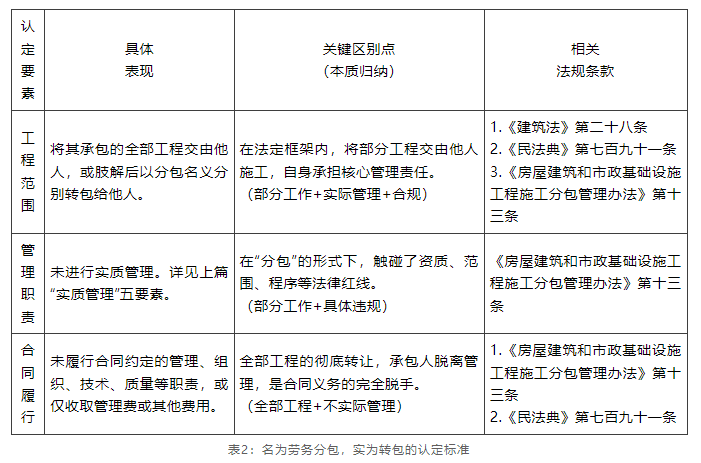
The construction of the main structure of the project must be completed by the contractor (the general contractor). If the main structure is also subcontracted, regardless of the proportion, it will be directly regarded as illegal subcontracting (except for steel structure projects). This is the most crucial criterion for determination.
2. If the main structure is completed independently but the scale is too small and the management responsibilities are not fulfilled, it constitutes "subcontracting".
"Large-scale subcontracting" itself is not an independent illegal type; rather, it is merely a manifestation of the fact of subcontracting or illegal subcontracting.
Regarding the proportion of the project that the general contractor is required to complete independently, there are no clear regulations in the laws and regulations.
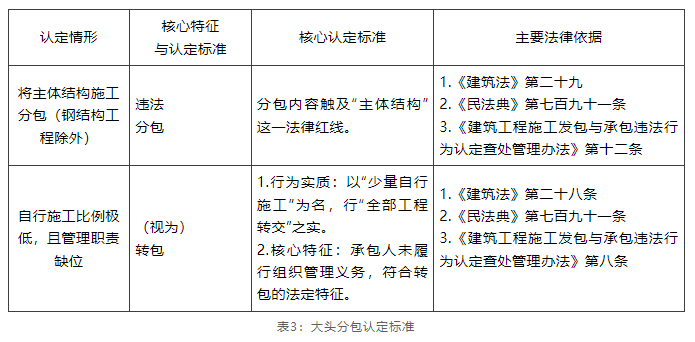
Conclusion: Regarding "large-scale subcontracting", the focus of legal evaluation is not the "proportion" itself, but the "illegal subcontracting entity structure" hidden behind this fact or the substantive illegal act of "transferring the contract".
II. Risks and Legal Consequences
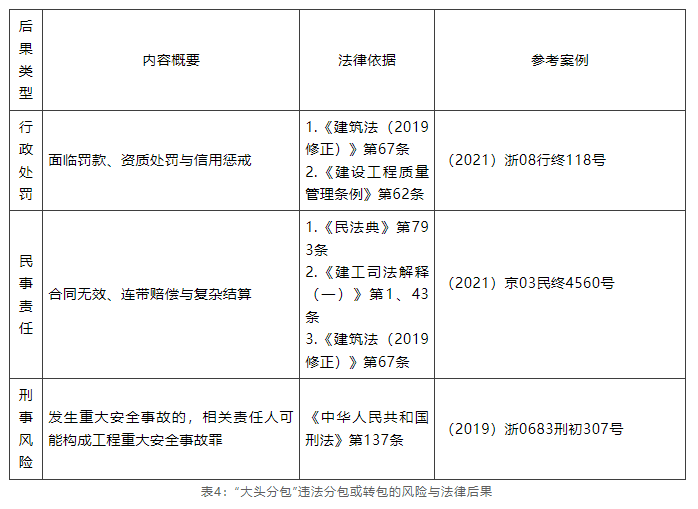
"Large-scale subcontracting" is of a nature that falls under illegal subcontracting or subcontracting. Once it is identified, the involved entity (the contractor) will simultaneously face administrative penalties, civil liability for compensation, and legal consequences of contract invalidity; if it leads to major engineering quality and safety accidents, the directly responsible personnel may also be held criminally liable.
III. Compliance Operation Suggestions
Regarding the issue of "major parts being subcontracted" (illegal subcontracting and overstepping of contract boundaries) in construction projects, the following compliance operation suggestions are provided:
(1)
Preliminary review and contract standardization process
1. Thoroughly review the qualifications of the subcontractors: Before subcontracting, verify whether the subcontracting units possess the legal qualifications that are compatible with the subcontracted projects, and keep relevant evidence materials. It is strictly prohibited to subcontract the project to individuals or units that do not have the required qualifications.
2. Standardize subcontracting content and proportions: It is prohibited to subcontract or transfer the main structure, key projects, or the entire project. Subcontracting should be limited to professional subcontracting or labor subcontracting, and must comply with the contract and legal provisions.
3. Improve the terms of the subcontracting contract: The subcontracting contract should clearly specify the scope of subcontracting, quality standards, safety responsibilities, time requirements, payment methods, and liability for breach of contract, to prevent illegal situations such as "deceptive subcontracting" and "affiliation".
(II)
Process Management Phase
Strengthen internal compliance training: Regularly conduct subcontracting compliance training for managers and project leaders to enhance their compliance awareness.
2. Improve project management system: Establish subcontract management, labor management, and project payment ledger systems to ensure that every step is traceable and auditable.
3. Strengthen on-site management and process supervision: The general contractor should conduct full-process supervision over the construction process of the subcontractor, implement the responsibility system of the project leader, and prevent the actual construction personnel from losing control.
Eliminate internal "project managers" as the main contractors for projects: Internal team contracting should only involve labor services and must not be carried out under the guise of a project manager. Moreover, the team members should sign labor contracts and purchase social insurance.
4. Maintain communication with the competent authorities: Actively accept guidance and supervision from the authorities, and keep abreast of the latest policy developments.
(III)
Risk Response Phase
Evidence collection: Preserve the qualification certificates of subcontractors, subcontract agreements, the consent documents of the employer, and the records of construction process management, etc., as the key evidence.
Self-inspection and self-correction: If any illegal subcontracting or over-assignment behavior is discovered, it should be promptly rectified.
Litigation response: In case of disputes over project payment, it is necessary to review the validity of the contract, the subcontracting process, and the payment facts. Reasonably design the litigation claims, and focus on the key dispute points such as contract invalidity, project payment settlement, and liability for compensation.
In conclusion, the "major part subcontracting" issue in construction projects is extremely risky. It is imperative to strictly control it from multiple dimensions such as subcontractor qualification review, contract clause design, process management, and risk prevention, in order to effectively prevent illegal subcontracting and transfer of contracts, and ensure the smooth progress of the project and the legitimate rights and interests of the enterprises.
03
Prohibition of subcontracting by subcontractors
This chapter focuses on the legal prohibition in the construction industry that "subcontractors shall not further subcontract the projects they have contracted". The core of compliant operation lies in strictly reviewing the subcontracting chain, ensuring that the main structure is constructed independently, and avoiding being regarded as a subcontracting.
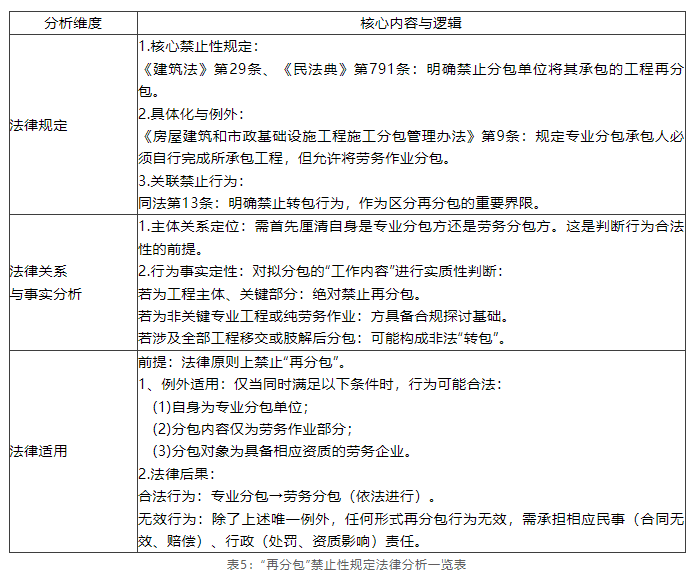
I. Legal Analysis of Prohibitive Regulations on "Re-subcontracting" in Construction Projects
II. Compliance Operation Suggestions
(1)
Pre-review stage
Review the contract: Carefully review the main contract signed with the contractor (or the general contractor), clearly identifying the stipulated clauses regarding "subcontracting" and "re-subcontracting". Confirm whether re-subcontracting is permitted and whether written consent is required, etc.
2. Determine the nature of the work: Clearly define the content of the work to be re-subcontracted. The main structure project is strictly prohibited from being re-subcontracted. If it is a non-main or non-critical work and in the project general contracting model, there may be a basis for compliance discussion. If one is a labor subcontractor, one should firmly avoid the re-subcontracting behavior, as the risk is extremely high.
3. Strict qualification review: For the potential sub-contracting units to be collaborated with, their 'Business License', 'Construction Enterprise Qualification Certificate', 'Work Safety Permit' and other relevant documents must be examined to ensure that their qualification levels, scope of contracting and the projects to be sub-contracted are all in complete alignment. All qualification documents should be photocopied and archived.
(II)
Standardize the subcontracting cooperation process
Obtain written consent
If the main contract stipulates that subcontracting is required with prior approval, it is essential to submit a written application to the client (or the general contractor) and obtain a clear written consent document from them. This is the key evidence to avoid risks related to contract validity.
2. Sign a complete written contract
Sign a contract with clear rights and responsibilities. The contract should clearly stipulate: the scope and content of the project, quality standards; the contract price, payment methods and deadlines, as well as the provisions for liability in case of breach.
3. Project Schedule and Liability for Breach of Contract
Add special provisions: Prohibit subcontractors from subcontracting or engaging in affiliation. Require them to cooperate in implementing the real-name wage management system and assume direct responsibility for the payment of migrant workers' wages.
(III)
Strengthening the management of the performance execution process
Implement penetration-based management: Incorporate the subcontracting units into the unified project management system and supervise their construction quality, safety, progress and labor usage.
2. Retain performance evidence: The system collects construction logs, contact forms, meeting minutes, acceptance forms, payment vouchers, etc. For important matters, communication can be conducted through email, work groups, etc. for retention.
3. Management of migrant workers' wages: Urge the subcontracting units to implement the real-name system and the management of dedicated wage accounts. The payment of wages must be made through the dedicated account of the general contractor, ensuring that the full amount is directly transferred to the bank cards of the workers.
(4)
Risk Management
For any suspected illegal acts such as subcontracting or borrowing qualifications, immediately terminate the cooperation and retain the evidence to prevent being held liable as a co-responsible party.
2. In case of disputes or being held accountable, it is recommended to collect all relevant evidence such as contracts, qualifications, communications, and payments as soon as possible, and assert one's rights or defend oneself according to the law.
In conclusion, priority should be given to ensuring compliance of subcontracting, the rigor of the contract, and the traceability of the execution process. This will effectively prevent risks such as invalid contracts, joint compensation, and administrative penalties. In case of any difficult situations, it is recommended to seek professional legal support promptly.
Mid-Chapter Summary
The distinctions among legal subcontracting, illegal subcontracting, and illegal subcontracting of projects are reflected in aspects such as the qualifications of the parties involved, the scope of subcontracting, management responsibilities, the legality of the procedures, the project scope, and the actual performance of management duties.
When it is determined that "what is called labor subcontracting is actually subcontracting", the criteria mainly include the scope of the project, management responsibilities, and contract performance. When the court reviews, it will penetrate the form of the contract and focus on the actual management and performance. Subcontracting or illegal subcontracting contracts are invalid, which may lead to administrative and civil liabilities, and even criminal prosecution. Compliance operations need to cover the entire process from pre-contract review, standard contract signing, process management and evidence retention.
3. There are two paths for identifying "large-scale subcontracting". Once it is determined that the legal consequences are the invalidation of the subcontracting contract, the relevant units will face administrative penalties, civil joint liability compensation responsibilities, and even criminal prosecution.
4. In construction projects, subcontractors are prohibited from further subcontracting the projects they have contracted. The only legal exception is that professional subcontractors can legally subcontract the labor operations within their contracted projects to qualified labor subcontractors with the corresponding qualifications. Any further subcontracting beyond this is illegal, and the relevant contracts are invalid and the parties involved shall bear legal responsibility.
However, once the contract is deemed invalid due to violation of regulations, how should the project funds, management fees, etc. be settled? (Part 2) This article will deeply analyze the settlement handling and compliance operation suggestions in cases where construction project contracts are invalid.


