








Subcontracting Legal Red Lines and Compliance Operations Practice (Part 2) - Guidelines for Project Payment Settlement in Cases of Invalid Construction Engineering Contracts
Preface
In the construction industry, cases where construction contracts are deemed invalid due to reasons such as failure to conduct legal bidding, lack of qualification, illegal subcontracting, overstepping of contractual boundaries, and violation of construction approval procedures occur frequently. How to settle such disputes is a common and complex issue in practice, often accompanied by an extremely complicated settlement process. This directly affects the survival rights of the contractors (or actual workers) and the stability of the construction market.
This article systematically analyzes the settlement rules for project construction contracts that are invalid: Firstly, it clarifies the legal basis for discount compensation and the "reference" system for settlement, and defines the scope of application of "reference to the contract agreement"; Secondly, it classifies and sorts out the settlement handling rules and legal basis for different project states based on whether the project has been completed and the acceptance results as dual criteria; Thirdly, around the independent validity of the settlement agreement and the handling of conflicts with the audit conclusion, it proposes compliance operation suggestions.
01 Settlement Principles
This chapter's introduction
After a construction project contract is determined to be invalid, the settlement of the project price directly concerns the core interests of both the contractor and the client, and is also a highly controversial issue in judicial practice. What principles should be followed for the settlement of the project price? After the contract is invalidated, on what basis should the amount of "compensation by discount" be determined? What is the scope of "reference to the contract terms"? How should it be operated in a compliant manner?
1. The core settlement principle for invalid contracts is "compensation by discount".
In the case of a construction project contract being invalid, the settlement of the project price is based on the qualified quality of the project and is guided by the core principle of "compensation through discount".
Legal basis: If a construction project construction contract is invalid, but the project has passed the acceptance inspection, the contractor can be compensated at a discounted price based on the contract's provisions regarding the project price. [See Article 793 of the Civil Code of the People's Republic of China (hereinafter referred to as the "Civil Code"). This provision is the specificization of the "compensation by discount" principle in the Civil Code in the field of construction projects.]
Legal basis: The claim for restitution of unjust enrichment does not require the presence of fault as a condition. Construction projects are immovable properties attached to the land. The labor and materials provided by the contractor cannot be returned in their original form; instead, a compensation through valuation is the only option. In the construction market, there are numerous calculation standards and diverse calculation methods for project prices, and it is difficult to determine a fair and impartial valuation compensation standard without referring to the contractual agreement. Referring to the contractual agreement for valuation compensation is conducive to balancing the interests of both parties and facilitating a convenient and reasonable resolution of disputes.
Rule System: Under the general provisions system of the Civil Code, Article 793 is a special provision for the construction industry based on Article 157. Together, they form a relationship between general law and special law.
II. The "reference" system for settlement basis
When a construction project contract is invalid but the project quality is qualified, the amount of compensation through discount should follow the hierarchical processing rules of "priority to agreement, reference as the main approach, and supplementary by appraisal", and the specific system is as follows:
First priority: Final settlement agreement between both parties (with independent mutual consent taking precedence)
The invalidity of the contract does not affect the validity of the independent settlement agreement reached by both parties regarding the project price during the performance process or afterwards. This agreement is a new confirmation of the creditor-debtor relationship between the two parties and should be regarded as the top priority basis for determining the project price. [See Article 29 of the "Interpretation (I) of the Supreme People's Court on Applying Law to Civil Cases Involving Construction Project Contract Disputes" (hereinafter referred to as "Construction Project Judicial Interpretation (I)")]
Related documents: The settlement agreement signed by both parties, the account statement, the engineering quantity confirmation sheet for financial review purposes, etc. If they reflect the final settlement agreement, they can also be classified under this category.
Second priority: Refer to the pricing standards and methods stipulated in the contract (the main reference path)
In the absence of a final settlement agreement, 【it should be based on Article 793 of the Civil Code】 and follow the contractual provisions regarding the project price for compensation through discount. The term "reference" here has specific scope and rules. The reference scope is, in principle, limited to the clauses that directly determine the value of the project, such as pricing standards, pricing methods, project scope, and quality standards.
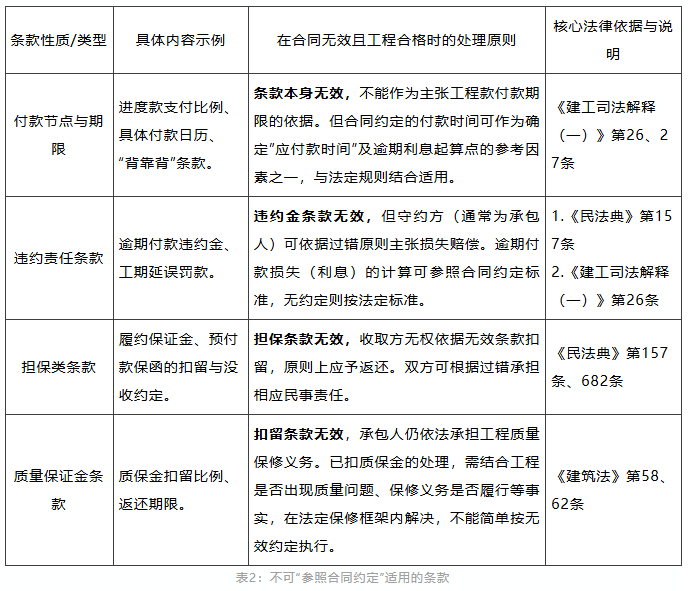
The performance-related provisions such as payment terms, construction period, liability for breach of contract, and guarantee clauses do not fall within the scope of reference. In the case of multiple invalid contracts: if all contracts are invalid, the actual performed contract should be referred to; if the actual performed contract is difficult to determine, the last signed contract should be referred to. [See Article 24 of the Construction Industry Judicial Interpretation (I)]
Scope Locking Principle: When settling based on the contractual agreement, the scope of the project as stipulated in the contract should be taken as the base. If the contractor claims to deduct the unconstructed part, they must bear the burden of proof that both parties have reached an agreement on the change of the project scope and the corresponding price adjustment.
Third priority: Determine the project cost through judicial appraisal (objective standard supplement)
In cases where the contract is invalid, priority should be given to the application of the agreed compensation terms. Only when the terms are unclear will an appraisal be initiated.
When the pricing method stipulated in the contract cannot be referred to (such as when the terms are unclear or the authenticity is questionable), or when there is a significant dispute over the project cost between the two parties, the amount of compensation based on the discounted price can be determined through judicial appraisal of the project cost. [See Article 793 of the Civil Code and Article 32 of the Construction Industry Judicial Interpretation (I)]
The "restrictions" for initiating the assessment:
If an effective settlement agreement has been reached, the appraisal shall generally not be permitted.
If the contract is for a fixed total price and there are no substantial and significant changes in the project scope or design standards, in principle, it is not supported to conduct a valuation of the entire project cost.
Fourth position: Determined based on market price or fixed quota standard (final guarantee rule)
When none of the aforementioned methods are applicable (for example, if there are no pricing agreements in the contract and the appraisal lacks a basis), the project price can be determined by referring to the market price information of the project location at the time of contract signing or the pricing quotas and standards issued by the construction administrative department. This method is also commonly used to determine individual costs such as materials supplied by the contractor and payment on behalf of the contractor that are not specified in the contract.
Special Note: Independent Path for Loss Compensation
The losses caused by contract invalidity such as work stoppage and idle labor, personnel severance fees, and losses from machinery and equipment leasing, fall under the category of liability for compensation due to fault and are in parallel with the aforementioned "discount compensation" system. When determining the extent of the losses, the provisions in the contract regarding the project duration, payment time, management fees, etc. can be used as the basis for calculation. However, the legal basis is the provisions on fault liability in Article 157 of the Civil Code, rather than directly referring to the contract's breach clauses.
III. Definition of the Scope of "In Accordance with the Contract Agreement"
(1) Mainstream view: Narrow interpretation
Core principle: Clearly distinguish between "pricing terms" and "performance terms"
The scope of "reference" does not cover the entire contract, but is strictly limited to "the stipulations regarding the project price", which are the terms that directly determine the calculation of the project value.
Legal basis: Differentiation between "discounted compensation" and "loss compensation"
The fundamental reason for adopting the restrictive interpretation lies in the separation of legal relationships:
Discount compensation: This refers to the value of labor and materials that have been physically incorporated into the construction project. According to the pricing terms, it is aimed at finding the most appropriate measurement standard that is agreed upon by both parties in advance and closest to this value, in order to achieve fair compensation.
Loss compensation: For other losses of reliance interests caused by the invalidity of the contract (such as停工 costs due to work stoppage and idleness, and personnel severance fees). This part should be shared according to the proportion of each party's fault as stipulated in Article 157 of the Civil Code. When calculating the size of the losses, the contractual provisions such as the construction period and penalty for breach of contract can be "referenced" as evidence, but the legal basis is the liability for fault, not "referencing" the contractual provisions themselves.
Practical significance: Avoid treating invalid contracts as valid ones
The limitation of interpretation prevents the invalid contract from being "revived" into a valid one. If the performance terms such as payment conditions and liability for breach of contract were allowed to be referred to, it would be tantamount to giving the invalid contract all the effects of a valid contract in terms of results. This is contrary to the legislative purpose of the invalid contract system. It ensures the logical consistency between the legal evaluation (invalidity of the contract) and the legal consequences (reduction of compensation).
Conclusion: "Contraction Interpretation" is a clear stance in current judicial practice. It precisely anchors the scope of "reference" on the value calculation clause, respecting the price agreement reached by the parties at the time of contract formation to achieve fairness, while adhering to the legal bottom line of contract invalidity. It is a key technical rule for balancing legal principles, fairness, and efficiency.
(2) Clauses that can be applied "in accordance with the contract terms"
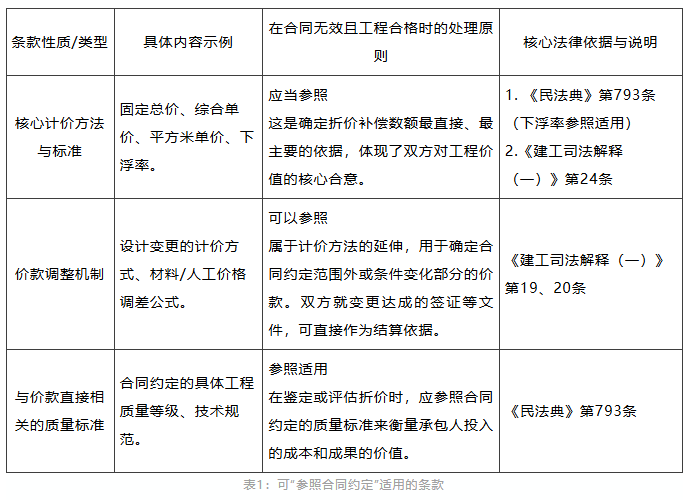
(III) Clauses that cannot be applied based on "reference to the contract terms"
(4) When a construction project contract is determined to be invalid, the handling methods under different settlement agreement models are summarized as follows:
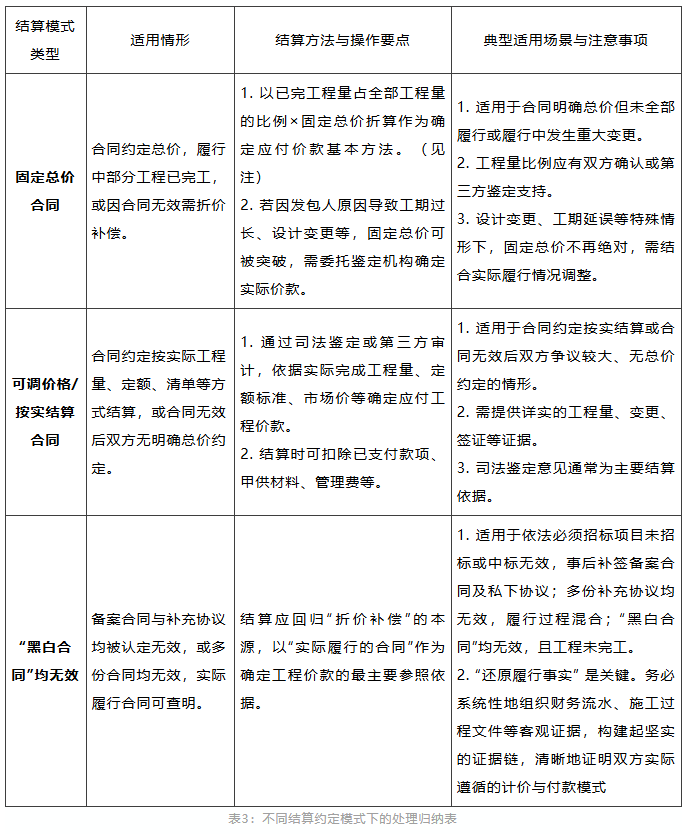
Note: The method of determining the payable amount based on the proportion of completed work to the total work quantity multiplied by the fixed total price is the most direct "reference to the contract terms" approach. It is in line with the legislative intent, is relatively simple in calculation, has higher judicial efficiency, and has economic predictability. On the other hand, "fixed-price settlement based on actual costs + downward adjustment to the fixed total price level" is a judicial discretion method reserved to address extreme unfair situations and achieve substantive justice. It is applicable only in specific exceptional circumstances.
(V) Practical Operation Suggestions
Before signing: Focus on prevention and review
Strictly review the validity of the contract: The primary task is to ensure the validity of the contract. The focus is on verifying the contractor's qualifications, whether the project falls within the scope of mandatory bidding, whether there is any subcontracting or illegal subcontracting, etc. This aims to prevent the risk of contract invalidity at the source.
Clarify pricing terms: Even considering the risk of invalidity, the pricing method, adjustment mechanism, and quality standards included in the price of the project should be clearly and explicitly stipulated in the contract. A contract with clear stipulations is still the most powerful basis for determining the amount of compensation for discount in case of invalidity.
In progress: Strengthening process management
Fixed performance evidence: Special attention should be paid to the signing and custody of documents such as project approvals, change negotiations, and meeting minutes. In the event that the contract is invalid, these documents are crucial evidence proving that both parties have reached new agreements on additional work or price adjustments, and can be directly used as the basis for settlement.
Standardize the management of income and expenditure: For performance bonds, advance payments, etc., pay attention to the conditions for their collection and return. Once a contract is determined to be invalid, promptly claim the return.
After the dispute occurred: Assert rights precisely
Precisely determine the litigation claim: If the contract is invalid, it should be claimed for "compensation based on depreciation" rather than "project payment", and at the same time, claim for the loss of funds (interest). Avoid directly claiming the penalty for breach of contract based on the invalid contract.
Reasonable selection of pricing basis: In litigation or arbitration, if the project is qualified, one should insist on requesting to settle the account in accordance with the pricing method stipulated in the contract. If the contract stipulations are extremely unfair (such as being below the cost price), a cost appraisal can be applied for, but one will need to bear a heavier burden of proof.
Handling the issue of retention of quality guarantee funds: As the employer, if the retention of quality guarantee funds has been made, in cases of contract invalidity, one should focus on arguing or filing a counterclaim from the perspective of whether the contractor has fulfilled the legal warranty obligations, rather than merely relying on the contract terms. As the contractor, one can claim that the deduction lacks contractual basis and demand the return of the funds.
02
Settlement processing for different project statuses in cases where the contract is invalid
This chapter's introduction
In the case of a construction project contract being invalid, how should the settlement and processing be carried out in different project states? This article divides the project states into: completed state & unfinished or halted state; and the acceptance situations into: acceptance qualified; acceptance unqualified, repairable; acceptance unqualified, irreparable or still unqualified after repair. For different situations, the settlement processing rules, legal basis and reference cases are sorted out.
1. The construction contract for the project is invalid.
Project payment settlement upon completion status
(1) In cases where the contract is invalid but the project has been completed and has passed the acceptance inspection, the core conclusion regarding the settlement of the project price is as follows.
Settlement standard: The discount compensation amount shall be determined based on the pricing standards and methods stipulated in the contract for the project price, rather than referring to the payment conditions, payment time, etc. clauses.
Applicable conditions: The qualification of the project quality is the prerequisite for the compensation at a discounted price as per the contractual agreement. If the project fails the inspection but becomes qualified after repair, the employer can request the contractor to bear the cost of the repair. (Article 793 of the Civil Code); If the project remains unqualified after repair, the contractor has no right to request compensation at a discounted price. (Article 793 of the Civil Code).
Handling of multiple contracts:
(1) Generally, settlement should be based on the contract that reflects the true intentions of the parties and has been actually performed.
(2) If the actual performance of the contract is uncertain, the settlement can be based on the final contract signed.
(3) In cases where it is impossible to determine, the court may, based on factors such as the difference in prices between the two contracts, the quality of the work, the fault of the parties, and the principle of good faith, determine a fair and reasonable amount for the compensation through valuation.
Settlement procedure: Both parties can negotiate on the settlement themselves or reach a settlement agreement; if they cannot reach an agreement through negotiation, the project price can be determined through judicial appraisal as stipulated in Article 32 of the Construction Engineering Judicial Interpretation (I); for fixed-price contracts, in principle, the application for cost appraisal is not supported as stipulated in Article 28 of the Construction Engineering Judicial Interpretation (I).
(2) The contract is invalid. Summary of the settlement of project prices under the condition of project completion.
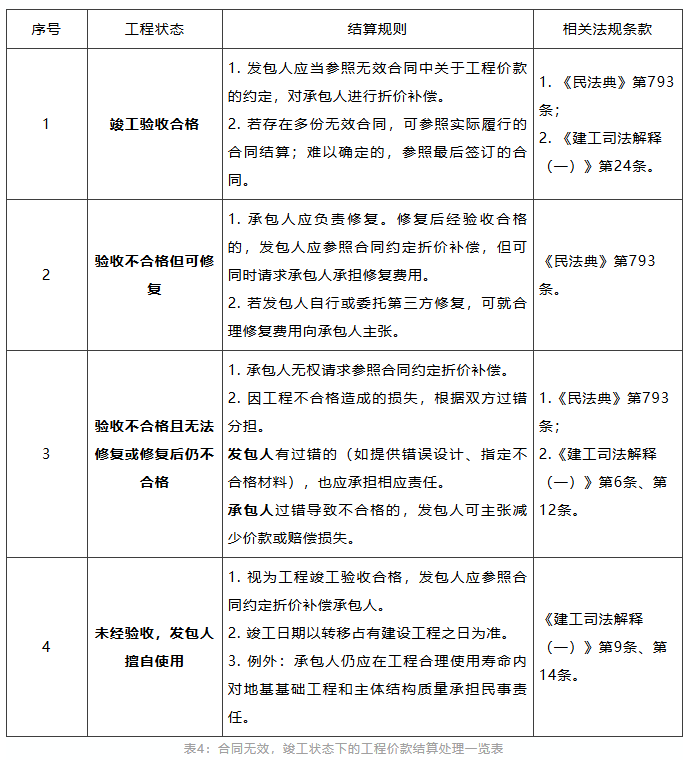
(III) Practical Operation Suggestions
Contractor's Operating Suggestions
Core: Collect and document the evidence of the project's completion and acceptance as qualified, or the actual use by the client (such as the completion acceptance report, handover records, usage certificates, etc.).
Settlement: The claim is to follow the provisions regarding the project price in the invalid contract for a discounted compensation. The party should first provide evidence of the actual performance of the contract and the price standard.
Interest and profits: Reasonable profits and losses due to capital occupation can be claimed (refer to the loan interest rate of the same period), but punitive clauses such as penalty fees will generally not be supported.
Action: Promptly issue a written notice to the contractor requesting payment. If negotiations fail, file a lawsuit and apply for property preservation.
Contractor's Operating Suggestions
Core: Review the reasons for the invalidity of the contract and one's own faults, and focus on verifying the project quality.
Settlement: If the project is qualified, compensation will be made at the agreed discount rate as per the contract; if it is not qualified, the contractor is required to make repairs. If the project remains unqualified after the repairs, the payment for the project can be refused and claims for loss compensation can be made.
Risk prevention and control: Avoid using the unfinished projects without prior acceptance. Once used, it will be regarded as an acceptance of the project quality (except for the quality responsibilities of the foundation and the main structure).
Evidence: Keep records such as repair notices, appraisal reports, loss vouchers, etc. If necessary, file a lawsuit or counterclaim.
General principle: If the contract is invalid but the project is completed and qualified, the settlement of the price shall be based on the contractual provisions as the core reference. Both parties should promptly fix the evidence and legally assert their rights to ensure that the settlement process is compliant and the risks are controllable.
II. The construction contract for the project is invalid.
Project payment settlement for unfinished or suspended projects
(1) Core conclusion on settlement of project price when the contract is invalid and the project is not completed or has been halted: The project price shall not be settled.
When the construction contract is invalid and the project is not completed or has been halted, the settlement of the project price shall follow the dual prerequisite principle of "quality compliance + confirmation of completed work volume".
Settlement prerequisite: The completion of the project with qualified quality constitutes the legal basis for claiming price reduction compensation. If the completed project has quality defects that cannot be repaired to a qualified state, the contractor has no right to claim the project payment (Article 793 of the Civil Code).
Settlement criteria: Firstly, both parties should seek confirmation of the completed project's price and the fact of arrears. This can be done through settlement agreements or confirmation letters, etc. If no consensus can be reached, the proportional conversion method is the mainstream approach to determine the fixed total price of the unfinished project's cost. The ratio of the completed project quantity to the total project quantity stipulated in the contract should be used as the basis for the discount, rather than simply settling based on quotas or market prices.
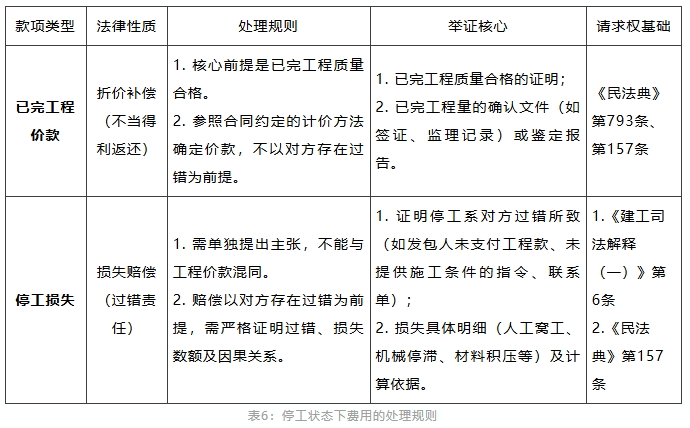
Work stoppage losses: Losses resulting from work stoppages or idleness caused by the employer fall within the scope of loss compensation. Such losses need to be claimed separately and the claimant must bear the burden of providing strict evidence. They cannot be directly handled by "referencing" the pricing provisions in the contract. If the contract contains provisions for calculating work stoppage losses (such as cost lump-sum), when determining the extent of the losses, the provisions of Article 6 of the "Construction Industry Judicial Interpretation (I)" can be referred to and applied.
(II) Settlement summary of project payment in cases where the contract is invalid, or where the project is unfinished or has been halted
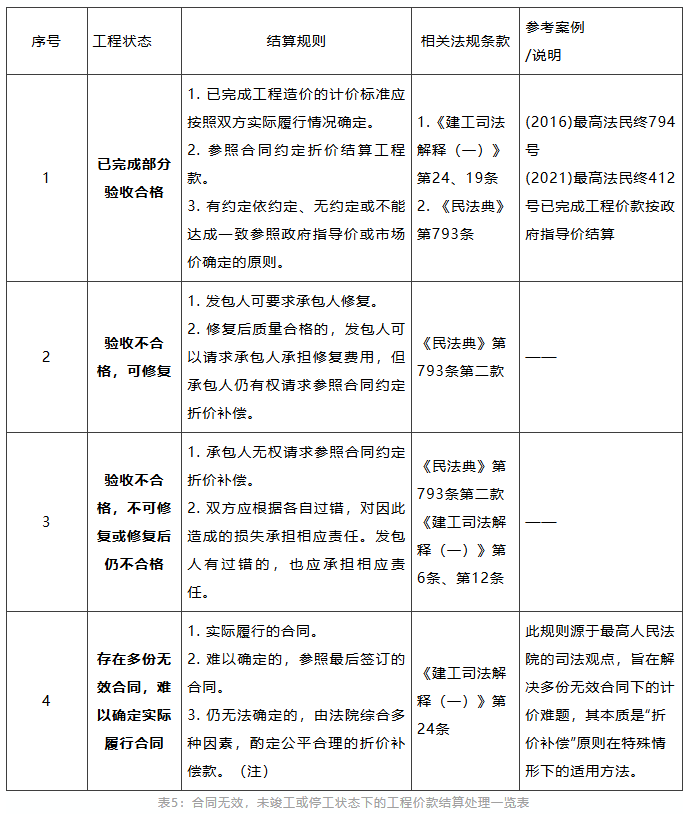
Note: For details, please refer to (1) Section 3 of the core conclusion regarding the settlement and processing of the project price when the contract is invalid but the project has been completed and accepted as qualified.
(III) Rules for Handling Costs During Shutdown Period
The costs during the suspension period can be classified into two categories: the price of completed works (discount compensation) and the losses due to suspension (damages compensation). These two have different legal natures and distinct bases for claim rights.
(4) Compliance Operation Suggestions
Based on the above legal framework, we have summarized the following compliance operation suggestions for you. The core principle is to immediately document the facts and distinguish between the two types of debts.
Evidence collection and project quantity confirmation
After the suspension of work or the invalidation of the contract, the contractor should immediately comprehensively document the completed project quantities, materials, machinery, etc. on the site through photos, videos, notarization, etc., and strive to reach a written confirmation with the employer and the supervisor (such as meeting minutes, visa forms). If no consensus can be reached through negotiation, a judicial appraisal should be promptly applied for.
Distinguish between discount compensation and loss compensation
For the completed projects that have passed the quality inspection, the contractor may request a discounted compensation for the project funds in accordance with the contract terms. The losses due to停工 (such as labor, machinery, and material backlog) should be claimed separately. It is necessary to provide clear evidence of the contractor's fault, the amount of losses, and the causal relationship.
Make good use of the contractual provisions and procedural clauses
Although the contract is invalid, the provisions regarding the pricing method, calculation standards for work stoppage losses, and the claim procedure in it can be used as references for loss determination and evidence preservation. The contractor should issue a claim notice in a timely manner as per the agreement to avoid affecting the substantive rights due to procedural errors.
Preventing the expansion of losses and personnel management
After the suspension of work, personnel and machinery should be properly evacuated. Records such as salary payments and separation agreements should be retained to prevent the expansion of losses and to provide a basis for subsequent claims.
Litigation Claims and Evidence Preparation
When filing the lawsuit, it is necessary to clearly distinguish between the two claims of "reduced compensation" and "work stoppage loss compensation", and prepare corresponding evidence for each. Pay attention to the validity of the jurisdiction clause and the dispute resolution method.
Carefully sign the settlement agreement
After the suspension of work, if a settlement agreement is reached, the agreement usually has independent validity. Before signing, it is necessary to ensure that the content is complete and the rights and obligations are clear to avoid disputes later on.
In conclusion, the settlement of project payment for unfinished or halted projects under a void contract mainly involves evidence collection, confirmation of project quantities, distinction of claims, compliance with procedures, and risk prevention, with the aim of maximizing legitimate rights and interests.
03
Settlement Agreement, Audit and Response
This chapter's introduction
Can the settlement agreement be valid independently of the construction contract? What should be done when the amount of the agreement conflicts with the audit conclusion? In the case of a contract being invalid, is the audit result still binding, and how should it be dealt with? This chapter addresses these issues and proposes compliance operation suggestions.
I. Settlement Agreement
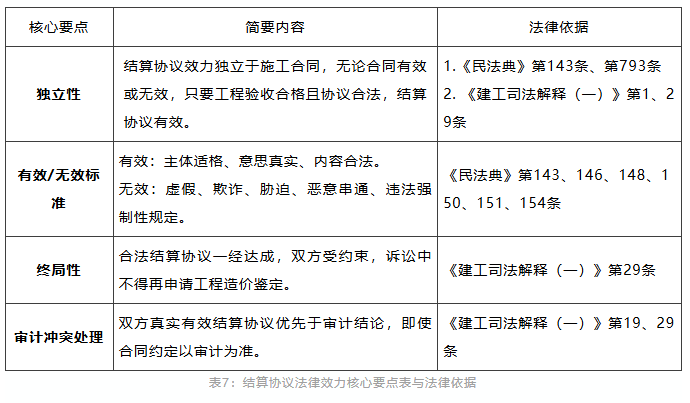
The construction project settlement agreement has independent legal effect and finality. Its validity should be independently determined based on whether it meets the effective conditions of civil legal acts. It will not be automatically invalid just because the original construction contract is invalid. Once it is legally and effectively reached, it will have binding force on both parties. Generally, it cannot be overturned or a cost appraisal application be made. However, its validity also has exceptions. If the agreement itself has legal invalidity or revocable circumstances, it may be negated.
(1) The legal nature of the settlement agreement
The settlement agreement is the mutual agreement reached by the contracting and construction parties regarding the final settlement and arrangement of rights and obligations related to the project price, etc. Its core legal attributes are manifested in the following aspects:
Effectiveness independence: Separation from the original construction contract's validity
The validity of the settlement agreement is independent of the original construction project contract. Even if the original construction contract is deemed invalid due to reasons such as the contractor lacking qualifications or the need for bidding but failing to do so, as long as the construction project passes the acceptance inspection, the contractor still has the right to request compensation at a discounted price in accordance with the contract terms. On this basis, the settlement agreement reached by both parties regarding the amount of the project price and payment is a new agreement that arranges for the consequences of the invalid contract. As long as this settlement agreement is the true intention of both parties and the content is legal, it has legal effect. The opinions of the judges' meeting of the Supreme People's Court also clearly support that "the invalidity of the construction project contract does not affect the validity of the settlement agreement". In judicial practice, courts also recognize that in the case where the construction contract is invalid, the settlement agreement signed by both parties can still be used as the basis for determining the project payment.
Final effect: Precedence of binding force and exclusion of appraisal
Once the settlement agreement is reached, it acquires "final" binding force. Unless there are legal flaws in the agreement itself, both parties must abide by it and cannot unilaterally overturn it on the grounds of the original contract terms or engineering endorsements. More importantly, it holds a priority position in the litigation process. According to judicial interpretations, if parties have already reached an agreement on the settlement of construction project prices before the litigation, and one party applies for an appraisal of the project cost during the litigation, the court will not grant permission. The finality of the settlement agreement aims to maintain transaction stability and avoid waste of resources.
Exceptions to Effectiveness: Invalidity and Revocability of the Agreement itself
The independence of the settlement agreement is not absolute. Its validity depends on whether it is legally valid. If the settlement agreement itself has any invalid or revocable circumstances as stipulated by law, its validity will be specifically invalidated. Mainly including:
(1) Inconsistency in the expression of intent: For instance, if one party signs the agreement under duress or fraud, or if the agreement is established under circumstances of manifest unfairness.
(2) Illegal or contrary to public morality: The content of the agreement violates the mandatory provisions of laws and administrative regulations that are of a substantive nature or the principles of public order and good morals. For instance, if a settlement agreement constitutes an illegal deviation from the substantive content (such as the project price) of the winning bid contract, it may face the risk of invalidity due to violating the mandatory provisions of the "Bidding and Tendering Law".
(3) Malicious collusion to harm the interests of others or entering into a contract through false representations.
(2) Handling of Conflicts with Audit Conclusions
When the settlement agreement between the two parties is inconsistent with the administrative audit conclusion, the handling principles are as follows:
Priority of Agreement: If the construction project contract clearly stipulates that "the final settlement shall be based on the conclusion of government/fiscal audit", and this stipulation is specific and clear, then the audit conclusion should generally be regarded as the settlement basis.
Settlement agreement takes precedence: This is the most fundamental rule. Even if the contract stipulates "subject to the audit", as long as both parties reach a genuine and valid settlement agreement before the completion of the audit or after the issuance of the audit conclusion, this settlement agreement constitutes a change or final confirmation of the original contract's settlement method and should take precedence over the audit conclusion. Audit is the administrative supervision of the construction unit by the state. In the civil field, the true consensus of the parties has a higher legal validity level.
Challenges of Audit Conclusions: If the contract stipulates that the audit shall be the final reference, but the audit department delays the conclusion for an extended period without valid reasons, or if the audit conclusion is obviously erroneous, untrue, or unobjective (such as pricing errors or illegal procedures), the contractor can request the court to determine the project price through methods such as supplementary appraisal, re-examination of evidence, or directly initiating judicial appraisal, without being restricted by the incomplete or flawed audit.
(III) Compliance Operation Suggestions
Signing stage: Ensure the validity of the settlement agreement
The content is clear and specific: The agreement must clearly specify the total project cost, the amount already paid, the amount still owed, the payment schedule, the quality guarantee deposit, and the liability for breach of contract. It should also incorporate any changes outside the contract, claims, and other matters, forming a "package" final solution to avoid ambiguity.
Authenticity of intention: Ensure that the agreement is the result of voluntary and equal negotiation by both parties. Keep records of the negotiation process, including meeting minutes, emails, and chat logs, as evidence in case it is later claimed that there was fraud or coercion.
Formally complete: It must be signed by the legal representative or an authorized agent with the appropriate authority and the company's official seal must be affixed to ensure the form is legally valid.
Performance and Dispute Phase: Making the Most of the Preemptive Effectiveness of the Settlement Agreement
Fixed evidence: Once an agreement is reached, a written agreement should be signed immediately and properly kept. This is the most powerful weapon to prevent the other party from later reneging and to prevent them from initiating a judicial appraisal on their own.
Dealing with Unfavorable Audits: If the contractor attempts to overturn the already valid settlement agreement with unreasonable audit conclusions, one should firmly assert rights based on the settlement agreement. A formal letter can be sent to point out the audit errors and state that the settlement agreement will be the sole basis for rights. In litigation, the independence and finality of the settlement agreement should be emphasized to the court.
Restricting the "based on audit" clause: As the contractor, during the contract negotiation, one should try to avoid such ambiguous or clauses that grant the owner sole decision-making power. If such clauses cannot be avoided, efforts must be made to stipulate clear audit deadlines and the consequences of overdue (such as "considering the submitted price as approved" or the possibility of applying for judicial verification).
Risk prevention: Reviewing the validity of the settlement agreement itself
Internal review: Before signing a major settlement agreement, it is necessary to review whether there are any invalid or revocable circumstances, such as whether it constitutes taking advantage of someone's vulnerability or being grossly unfair.
Preventing external risks: Be cautious about whether the agreement may harm the interests of third parties. For instance, by including a deferred payment clause to extend the payment period, it might undermine the contractor's priority right to claim for the construction project's price. There is a risk that such a clause may be ruled invalid.
Value in the case of an invalid contract: Even if a construction contract is invalid, as long as the project quality is qualified, actively promoting the establishment of an effective settlement agreement remains the best way to resolve the price dispute. It can quickly determine the creditor's rights and avoid lengthy and uncertain judicial appraisal procedures.
II. Audit and Response
(1) Core Conclusion
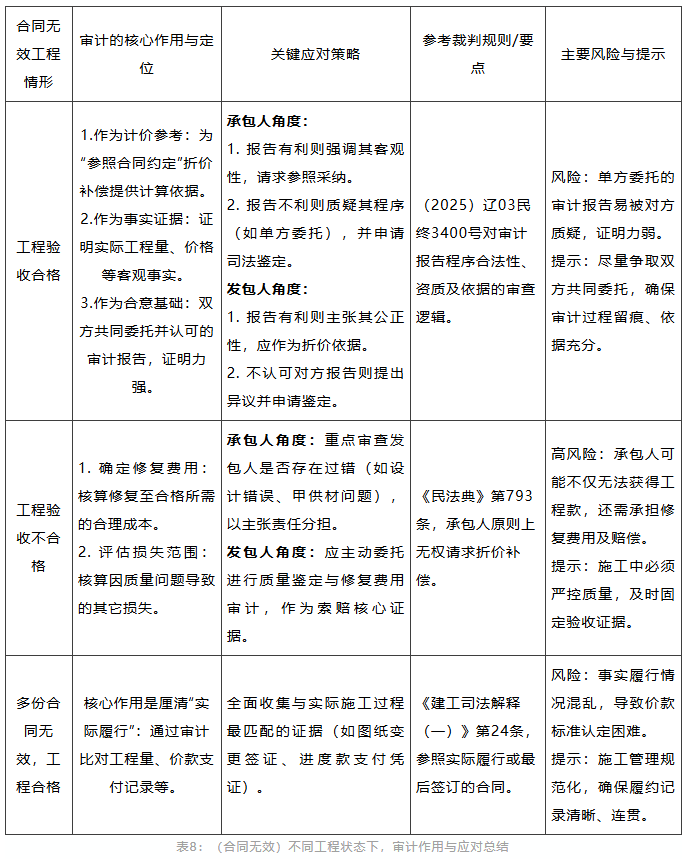
After a construction project contract is determined to be invalid, the provisions regarding the settlement of project prices (including the clause stating "the audit result shall be the final settlement basis") also lose their contractual binding force. At this point, the core legal principle for determining the project price is "reduction in price based on the contractual provisions regarding the project price for compensation".
Under this principle, the nature of the audit report (including government audits) has shifted from the settlement basis stipulated in the contract to a reference piece of evidence in civil litigation. The strength of its proof value needs to be verified through court examination and comprehensive review. The key points of the review include:
Procedural Legitimacy: Whether the audit is initiated based on a mutual commissioning agreement or in accordance with the agreed procedures;
Objective nature of the conclusion: Whether the audit content comprehensively and objectively reflects the actual situation of the project and the pricing basis stipulated in the contract;
Balance of rights: Especially for government audits, if the procedures are prolonged for a long time or the conclusions are obviously unfair, constituting an abuse of rights, they cannot be regarded as the natural basis for determining the price.
In practice, when the audit conclusion cannot be made promptly or there are significant flaws, courts often allow the determination of the cost to be made through judicial appraisal.
In practice, the determination of the project cost follows the following procedure:
First of all, try to follow the pricing standards for the project cost stipulated in the invalid contract.
Secondly, conduct a comprehensive review of all the evidence including the settlement agreement between the two parties, the audit report, and the construction documents.
Finally, if the aforementioned methods are unable to provide a definite conclusion, the judicial appraisal procedure can be initiated in accordance with the law.
The audit report is an important part of this evidence chain, but it is by no means the only or mandatory endpoint.
(2) Core Regulatory Basis
Article 793 of the Civil Code: It has established the basic principles for handling the project price after a contract is declared invalid. If the construction project has passed the acceptance inspection, the project price can be compensated to the contractor by reference to the agreement on the project price in the contract. The term "reference" here serves as the legal starting point for analyzing and auditing.
Construction Law Interpretation (I) Article 24: It further clarifies that when multiple contracts are invalid but the project is qualified, compensation can be made by reference to the actual executed contract or the last signed contract. This provides room for the audit report to ascertain the "actual performance situation".
Article 19 of the Construction Industry Judicial Interpretation (I): If there is an agreement on the pricing standards or methods, the settlement shall be made according to the agreement. In the context where the contract is invalid but can be "referenced", the agreements in the contract regarding the pricing methods and standards (such as which quota or information price to adopt) have significant reference value, while the mere payment conditions (such as "payment based on the audit conclusion") lose their binding force due to the invalidity of the contract.
(III) When a construction project contract is invalid, the role and response measures of auditing in different project scenarios are summarized as follows:
(4) The Relationship Between Audit and Judicial Appraisal
When there are significant disputes over the audit conclusion or it cannot be determined, judicial appraisal is the authoritative way to finally determine the price.
Breaking through the audit deadlock: If the contractual audit procedures cannot be completed for a long time, one can request a judicial appraisal to determine the price. In judicial practice, if the conditions for audit are not met due to reasons other than the contractor, the price can be determined through an appraisal.
Regardless of whether an audit is conducted or not, all settlement documents should be systematically collected to prepare for possible verification.
Note that the audit/determination period is too long, resulting in financial pressure.
Tip: In litigation, one can apply for interim measures or make a partial payment of undisputed amounts in advance to alleviate the pressure.
(V) Compliance Operation Suggestions
Based on the above legal provisions, judicial precedents and practical experience of enterprises, in response to the issue of "audit and its response" in the settlement of project prices when a construction project contract is determined to be invalid, the following professional and compliant operational suggestions are proposed:
Before the contract was signed
Clarify settlement and auditing terms: Clearly stipulate in the contract the pricing standards, settlement procedures, auditing entities, timeframes, and the validity of the conclusions. The key point is to clearly define the legal consequences of overdue auditing (such as treating it as the acceptance of the submitted price). For the "audit as the standard" clause, it is necessary to define its scope, methods, and the obligations of both parties to avoid ambiguity.
Review the validity of the contract basis: Thoroughly verify the qualifications of both parties to prevent the occurrence of invalid contracts due to illegal subcontracting or other violations. For government projects, it is necessary to ensure that the contract complies with local policies.
Compliance operations during the performance and settlement phases
Initiate and cooperate with the audit promptly: The contractor should submit the settlement documents in a timely and complete manner, and issue a written notice to the employer to initiate the audit. Both parties need to cooperate with the audit institution to ensure the authenticity and completeness of the materials.
Effective Handling of Audit Disputes: If there are objections to the audit conclusion, a written objection should be raised promptly and negotiations should be conducted. If the employer delays the audit without valid reasons, the contractor should issue a written notice and claim the consequences stipulated in the contract for overdue performance.
Prepare the final relief plan: If the auditing process remains unresolved for an extended period, it is necessary to prepare for determining the cost through judicial appraisal.
Dispute litigation stage
System preparation of evidence and requests: comprehensively collect evidence such as completion acceptance documents, submission of settlement materials, audit reminders, etc. Clearly define the litigation requests, including project payment, interest, and application for appraisal.
Decisively initiate and fully utilize judicial appraisals:When the audit cannot be completed or the conclusion is inaccurate, it is necessary to promptly apply to the court for an engineering cost appraisal and cooperate actively. The clause in the contract stating "failure to submit within the deadline is regarded as acceptance of the submitted price" can be used as an important basis for negotiation or litigation.
Clearly assert legal rights: Even if the contract is invalid, in litigation, one should still claim to be compensated at the agreed price stipulated in the contract. If the contractor delays the audit, directly claim to settle according to the overdue clause of the contract or request a judicial appraisal.
This summary
/ DHHT Law Firm
The settlement of project prices in cases where construction project contracts are invalid is a core issue that frequently causes disputes and involves complex legal relationships in practice. This article systematically analyzes the handling of price settlements in cases where contracts are invalid.
I. Establishment of Settlement Principles. Clarify the legal basis for compensation of invalid contracts through price reduction, analyze the normative attributes of "reference to contractual terms", define the applicable scope and boundaries, and provide corresponding compliance operation suggestions.
II. Classification and Handling of Engineering Progress Status. The primary distinction criterion is whether the project has been completed, which is divided into the completed status and the unfinished or halted status; then, based on the quality acceptance results as the secondary criterion, it is classified into three scenarios: acceptance qualified, acceptance unqualified but repairable, acceptance unqualified and irreparable or still unqualified after repair. Each category is separately sorted out and the settlement handling rules are specified along with the legal basis. On this basis, the key points of compliant operation are summarized.
III. Special Issues in Settlement. Analyze the practical difficulties such as the independent validity of settlement agreements, the relationship between auditing and project settlement, and their judicial responses, and propose operational compliance suggestions.
04
Conclusion
This series consists of three parts: the upper, middle, and lower sections. It starts with the legal regulatory framework of engineering subcontracting, centers around the criteria for identifying illegal acts and their legal consequences, and concludes with the settlement handling after contract invalidation. This forms a complete closed loop from "rule cognition" to "risk identification" and then to "consequence handling". The three parts are interrelated and progressive: the upper part addresses "what is the red line", the middle part answers "where is the red line", and the lower part explains "how to handle after crossing the line". Together, they constitute the practical operation system for engineering subcontracting compliance management. Although it strives for a systematic approach, the problems and disputes in engineering subcontracting practice are far beyond what can be covered by the above content. Compliance is not only a legal bottom line issue but also an integral part of an enterprise's core competitiveness. Only by internalizing the rules into the management process can risk be controllable and business sustainable.


