








From a practical perspective, analyzing the potential liability of investors and directors
Preface
Investors appoint directors to target companies, which is a common governance arrangement in the investment and financing process. The directors appointed by investors are often senior managers of the investors and represent the investment interests of the investors in participating in the company's board of directors' decision-making (even having the right to veto), while they also serve as directors of the target company and are obligated to be loyal and diligent to the company. When the investor's position and the company's position diverge, the dual identities of the investor directors during their performance of duties are prone to generate conflicts, especially in situations such as poor company performance, flawed capital contributions, bankruptcy liquidation, and repurchase disputes. Will the investor directors, who fully represent the investor's position, accidentally violate their legal duties during this process and thus be liable for compensation? This article analyzes from the perspective of liability provisions in the "Company Law", case studies, and transaction clause design to provide references for investors and their appointed directors to identify performance risks and improve compliance arrangements.
01 Compensation Liability Clauses that Investor Directors May Involve
The provisions on director compensation liability in current laws and regulations are scattered across multiple clauses, covering situations such as improper performance of duties, illegal distribution, illegal reduction of capital, and illegal liquidation. The following table organizes the legal compensation clauses that directors may be involved in according to liability types:
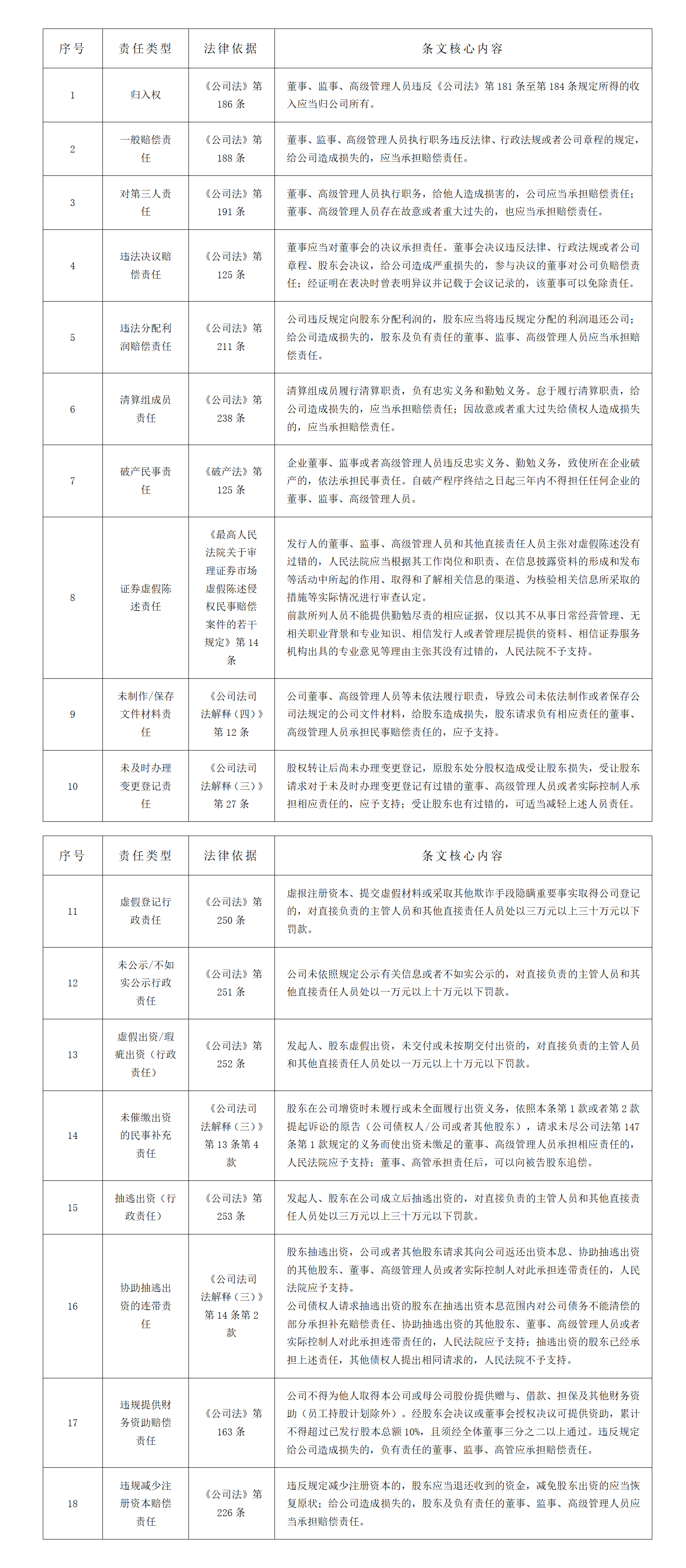
The table above lists the types of responsibilities that directors may be involved in. Among them, the most worthy of attention for investors are the liability for withdrawing capital contributions and the liability for compensation for failing to collect capital contributions. During the process where investors require founding shareholders to repurchase their equity, if the investor directors assist in the repurchase but fail to fully comply with the relevant procedures, such as transferring funds when the company has not completed capital reduction or has not fulfilled the creditor protection procedures, it may constitute assisting in the withdrawal of capital contributions, and thus face the risk of bearing joint liability. At the same time, the directors appointed by the investors have the legal duty to urge the investors to make timely capital contributions. Although in practice, investors often complete the transaction and the closing conditions are met immediately after signing the transaction documents, there are also situations where investors make installment payments for additional capital contributions or fail to pay the final installment of additional capital contributions for a long time. In such cases, appointing directors will undoubtedly put them in a dilemma: on the one hand, as the appointer of the investor shareholders, the directors themselves may not have made the capital contributions, and if they initiate the collection procedure based on their authority, they will face the problem that the object of the collection is their appointer; on the other hand, if the directors are negligent in collecting, they may need to bear compensation liability to the company's creditors, the company, or other shareholders. These two types of responsibilities are clearly the risk points that investor directors need to be most vigilant about.
02 Compensation Liability that Investor Directors May Bear in Judicial Judgments
Whether investor directors should bear compensation liability cannot be generalized. The logic of court judgments varies substantially depending on the type of behavior, subjective motivation, and status. The following five cases cover both directions of liability and present the basic path for court differentiation and judgment.
(1) Liability of Investor Directors
The cases of Smanet Company [1], Zixing Puand Bank [2], and Shangda Printing Company [3] jointly clarified the typical circumstances under which investor directors should bear liability. In the Smanet Company case, the court determined that the investor directors failed to fulfill their duty of collecting the investors' capital contributions and ordered them to jointly compensate 4.91 million US dollars. The Zixing Puand Bank case and Shangda Printing Company case involved investor directors assisting investors in withdrawing capital contributions. The court ordered the investor directors to bear joint liability. Although the cases were different, they all reflected the two most common reasons for investor directors to bear liability, as follows:
1. Smanet Company case - Investor directors had the convenient conditions to supervise the investors' fulfillment of capital contribution obligations
In the Smanet case, the 4.91 million US dollars of capital contributions made by the shareholder, Cayman Smanet Company, were never actually paid, resulting in the bankruptcy liquidation of its Chinese sole proprietorship enterprise, Shenzhen Smanet Company. The Supreme People's Court held that Hu et al. six directors also served as directors of Shenzhen Smanet Company and the shareholder, Cayman Smanet Company, and should have been aware of the assets and operation status of the shareholder, Cayman Smanet Company. They had the convenient conditions to supervise the fulfillment of capital contribution obligations by the shareholder, but never carried out the collection obligation. This was a violation of the duty of diligence through passive non-action, and there was a legal causal relationship between this non-action and the losses of Shenzhen Smanet Company. Therefore, the court ordered the six directors to jointly compensate 4.91 million US dollars. This case indicates that directors with dual identities have more information about the investors' capital contribution conditions, and this information advantage actually increases their duty of care. In such circumstances, when the court determines the causal relationship, it does not need to prove that the directors had additional positive actions, but can directly base the non-action of not fulfilling the collection obligation on the director, and order the directors to bear joint liability.
2. Zixing Puand Bank case - Investor directors cannot act passively based on the self-interest of the shareholders
In the Zixing Puand Bank case, Shenzhen Zhonghuanke Company, as the shareholder of Chenzhou Zhonghuanke Company, appointed Yao as the executive director and legal representative of Chenzhou Zhonghuanke Company on September 5, 2012. On October 30 of the same year, Shenzhen Zhonghuanke Company transferred 9.4 million yuan of the investment funds from the account of Chenzhou Zhonghuanke Company back to its own account. When the funds were transferred, the remittance voucher had the official seal of Chenzhou Zhonghuanke Company and the personal seal of Yao. Yao contended that he was in Beijing on business at that time and did not participate in the transfer. The personal seal was not signed by him.
The court held that Yao, as the executive director of the company, had the obligation to be diligent, cautious, and highly attentive. He should not be influenced by the self-interested actions of the shareholders and should independently manage the company's assets. However, "due to the influence of the shareholders' self-interested actions, he performed his duties passively, allowing the act of Shenzhen Zhonghuanke Company to withdraw the investment funds to be realized. " Afterward, he did not actively perform his duties to recover the withdrawn funds, constituting assistance in the withdrawal of investment funds. The court held him responsible for joint liability. This judgment indicates that even if an investor director does not actually assist the investor in withdrawing the investment funds, he may still be deemed to have assisted in the withdrawal of investment funds due to violating the obligation of independent management of the company's assets and the obligations of diligence, caution, and high attention.
3. The case of Shangda Printing Company - Executing the investor's instructions does not constitute a defense for the investor director
In the case of Shangda Printing Company, Shanghai Yichenjia Printing Co., Ltd. invested in and became a new shareholder of Shanghai Shangda Printing Co., Ltd. in 2010 and transferred 4.25 million yuan of the investment funds from the account of Shangda Printing Company to its own account in April of the same year. After the investment and shareholding, Yichenjia Company appointed Lin as the supervisor of Shangda Printing Company, responsible for managing the company's finance department. Later, Lin also served as the chairman, general manager, and legal representative of Shangda Printing Company, and admitted that the 4.25 million yuan paid by Shangda Printing Company to Yichenjia Company in April 2010 was done in accordance with the instructions of Yichenjia Company. Based on this, the court held that "whether from the perspective of the director's diligence and conscientiousness obligations or the obligation to assist in withdrawing funds, Lin should bear the responsibility in this case." Thus, it can be seen that executing the investor's instructions does not constitute a defense for the director. The director's duty of loyalty and diligence always points to the company, and acting according to the investor's instructions constitutes a violation of his fiduciary obligations.
(II) Circumstances where the investor director does not bear responsibility
The judicial practice on whether the investor director bears responsibility is not uniform. The following two cases show different paths for the court to determine that the investor director does not bear responsibility. The case of Taiqi Company [4] holds that the investor director is exempted from liability due to the lack of subjective motivation to infringe upon the company's interests. The case of Youji Company [5] specifically considers the special identity of the investor director and holds that the degree of the investor director's duty of loyalty to the company is lower than that of the founding shareholder director.
1. The case of Taiqi Company - Whether the investor director bears responsibility should consider his subjective motivation
In the case of Taiqi Company, Taiqi Company was a Sino-foreign joint venture, with 95% of the shares held by the foreign shareholder. Mai was the director appointed by the foreign shareholder and also served as the chairman and legal representative. After the foreign shareholders had a disagreement over the company's business plan, Mai sent a letter to the bank to freeze the company's account and filed a lawsuit for preservation. Based on this, Taiqi Company claimed that Mai had violated the duty of loyalty and diligence. The Shanghai Second Intermediate People's Court held that Mai's actions of freezing the account and filing a lawsuit for preservation were measures taken in a specific situation for relief and did not constitute an infringement of the company's interests or violate the duty of loyalty and diligence that a director should fulfill. The court also particularly considered the equity structure where the foreign shareholder held 95% of the shares, and determined that Mai's actions did not objectively infringe upon the company's interests, so it ruled that he did not bear compensation responsibility. This also indicates that when the investor director takes measures to protect the overall interests of the company and objectively does not cause damage to the company, the court tends to not pursue liability.
2. The case of Youji Company - The degree of the investor director's duty of loyalty is lower than that of the founding shareholder director
Dehui Jinghe Company is a specialized investment institution registered with the China Securities Investment Fund Association. After signing an investment agreement with Youji Company and the company's founding shareholder Qu, it appointed Bian as the director of Youji Company. Not long after, Bian, along with the founding shareholder Qu who also held the position of director, established Qinggong Company, which engaged in similar business as Youji Company. This action was challenged by the company.
Regarding whether the two individuals should bear liability for damages to Youji Company due to their failure to fulfill the duties of loyalty and diligence, the court held that Qu, as the founding shareholder and director, had a higher duty of loyalty to the company and should bear the liability for damages. Dehui Jinghe Company, as a specialized investment institution, aimed to obtain investment returns and sending directors to participate in the management of the company was an industry practice in the investment sector. The director appointed by Dehui Jinghe Company, Bian, had a lower degree of duty of loyalty to the company compared to the founding shareholders. Since Youji Company failed to operate well after the investment and had poor business performance, the investor director established another company engaged in similar business based on their optimistic view of the industry. There was no obvious impropriety. This case directly combined the special identity of the investor director and emphasized that in the case where an investment institution, based on industry practice, appoints a director to the invested company, the duty of loyalty of the investor director to the company is lower, reflecting the judicial thinking of differentiating the determination of the duty of loyalty.
03
The risk isolation arrangement for investors and directors in the transaction documents
As mentioned earlier, investors and directors face the risk of being held jointly liable in scenarios such as demanding the payment of capital contributions. Based on the experience of numerous investment and financing transactions that I have led previously, investors can establish a risk isolation mechanism between the director position and liability assumption through the specific design of the transaction documents. Specifically, there are the following several paths that investors can refer to:
1. Reserve the right to nominate directors but do not exercise it immediately. In the agreement, investors agree to have the right to nominate directors to the board of directors, but do not actually appoint directors after the investment is completed. They only participate in the company's governance as shareholders through the shareholders' meeting. Under this arrangement, investors retain the right to vote on major matters of the company and avoid having their appointed personnel directly assume the duties of loyalty and diligence.
2. Abandon the director position and instead set up an observer position. Investors do not appoint directors but require the establishment of an observer position in the board of directors. The observer has the right to attend board meetings, review meeting materials, and obtain company operating information, but does not have the voting right and does not assume the legal obligations of a director. This arrangement ensures the investor's right to know while cutting off the generation of director liability at the source.
3. Appoint directors but set exemption clauses. If investors choose to appoint directors, they can clearly stipulate in the transaction documents the circumstances of exemption, including but not limited to: the act of the appointed director exercising voting rights based on the investor's instructions does not constitute a violation of the duty of loyalty; the appointed director does not bear compensation liability for the losses of the company's operation and management, except for intentional or gross negligence; the company and the founders promise to compensate for the losses suffered by the appointed director due to normal performance of duties. At the same time, the purchase obligation of director liability insurance can be agreed upon in the company's articles of association or investment agreement, with the company bearing the insurance premium.
It should be noted that the validity of the above exemption clauses is uncertain. From the perspective of legal nature, the duties of loyalty and diligence of directors are legal obligations. Whether the exemption agreement in the transaction documents can counteract legal obligations depends on the specific setting of the clause. Requesting the company and the founders to promise to compensate for the losses of the appointed directors has a relatively reasonable basis; while a clause that completely exempts the director from liability, such as the act of exercising voting rights based on the investor's instructions does not constitute a violation of the duty of loyalty, is very likely to be deemed as violating mandatory legal provisions and invalid. In practice, it is advisable to consider the combination of the company and founders' commitment and the purchase of director liability insurance rather than relying solely on exemption clauses.
4. Shift the decision-making authority to the shareholders' meeting level. Investors can stipulate in the company's articles of association and investment agreement that the decision-making authority of major matters of the company be shifted to the shareholders' meeting, reducing the scope of authority of the board of directors and lowering the risk that the investor's directors will bear personal liability due to decision-making errors during their performance of duties. However, it should be noted that the second paragraph of Article 10 of the new "Company Law Interpretation (for public comment)" stipulates that the shareholders' meeting has no right to exercise the powers that are legally reserved for the board of directors. [6] Although this interpretation has not been officially promulgated, to avoid future compliance risks, in the design of the transaction documents, if investors intend to shift more decision-making authority to the shareholders' meeting level, they can make adjustment agreements on matters that are not legally reserved for the board of directors, that is, stipulate that other powers not included in the legal powers of the board of directors shall be exercised by the shareholders' meeting.
Conclusion
The issue of compensation liability for investors who appoint directors essentially concerns how to resolve the contradiction between the legal obligations of directors and the appointment relationship. Based on the director's position, directors have independent and diligent obligations to the company. Based on the investor's executive position, they need to be responsible for the investor's interests during their duties. The author suggests that appointed directors should strengthen the compliance requirements for bilateral performance of duties. If they are to serve as appointed directors, they should make careful designs at the transaction document stage regarding the necessity of the director seat, the coverage of the exemption arrangement, and the distribution structure of decision-making authority. During their daily performance of duties, they should also pay attention to the scale of their own behavior being in line with the provisions of the Company Law and the internal management norms of the investor's company.
Footnote
[1] Reversal of the Judgment in the Case of Damage to Company Interests by Shiman Te Micro Display Technology (Shenzhen) Co., Ltd. and Hu et al. (Reconsideration), Supreme People's Court of the People's Republic of China (2018) Supreme Court Civil Reconsideration Case No. 366.
[2] Case of Damage to Company Creditors' Interests by Zixing Huadepu Rural Bank Co., Ltd. and Yao et al., People's Court of Zixing City, Hunan Province (2022) Xiang Shing 1286 Civil Judgment.
[3] Case of Shareholder Damage to Company Creditors' Interests by Shanghai Xiangde Printing Equipment Co., Ltd., Shanghai Shangda Asset Management Co., Ltd., and Shanghai Yichenjia Printing Co., Ltd., and Zhou et al., Second Intermediate People's Court of Shanghai (2020) Shanghai 02 Civil Appellate Case No. 865.
[4] Case of Damage to Company Interests by Shanghai Taiqi Real Estate Co., Ltd. by Mai, Supreme People's Court of Shanghai (2019) Shanghai 02 Civil Appellate Case No. 11661.
[5] Case of Damage to Company Interests by Qu et al. by Youji (Beijing) Sports Products Co., Ltd., Second Intermediate People's Court of Beijing (2023) Beijing 02 Civil Appellate Case No. 6785.
[6] Article 10, Paragraph 2 of the Draft Interpretation of Several Issues Concerning the Application of the Company Law of the People's Republic of China (for public comments): If the shareholders' meeting violates the law and grants the powers that should be exercised by the shareholders' meeting to the board of directors, or transfers the powers that should be exercised by the board of directors to the shareholders' meeting, and the parties request to confirm the invalidity of such resolution, the people's court shall support it. If the shareholders' meeting or the board of directors exceeds its authority and makes a resolution that is not within the scope of the company's resolution, the parties request to confirm the invalidity of such resolution, the people's court shall support it.


-
Prev:Enterprises use the AI compliance self-inspection checklist - based on the latest provisions of the "Opinions of the Supreme People's Court on the Adjudication of Dispute Cases Involving Artificial Intelligence"
-
Next:Summary of Expert Insights on Commercial Litigation: The Validity Determination of Shareholders' Meeting Resolutions for Capital Increase in the Context of Company Capital Shortage