








Interpretation of the "Guaranteed Completion of Housing Project Rules" in the "Meeting Minutes of the National Court Conference on Handling Bankruptcy Cases of Real Estate Development Enterprises" (Part 1): The Hierarchical System for Protecting Homebuyers
Preface
In recent years, the debt risks of real estate development enterprises have been exposed in a concentrated manner, with numerous projects being halted and abandoned, and groups of homebuyers facing the situation where both their house purchase money and the houses themselves are lost. Such mass disputes have become an important factor affecting social stability. Against this backdrop, on September 4, 2026, the Supreme People's Court issued the "Meeting Minutes on the Trial of Bankruptcy Cases of Real Estate Development Enterprises" (hereinafter referred to as the "Minutes"), providing systematic judicial guidance on core issues such as the protection of homebuyers in bankruptcy cases, continuation of construction financing, priority of construction project payment claims, and conflicts of mortgage rights. Although the Minutes are not laws or judicial interpretations and cannot be directly cited as judicial references, they serve as a special guiding document for the Supreme People's Court to unify the judicial standards for real estate development enterprise bankruptcy cases across the country. They have substantive binding force on courts at all levels in handling such cases and have significant practical guiding value for bankruptcy administrators, financial institutions, construction enterprises, and homebuyers.
This article focuses on the core institutional goal of "protecting the completion of houses" in the Minutes, from the perspectives of homebuyer protection and continuation of construction financing, and deeply interprets its rule structure, legal basis, interest balance mechanism, and practical operation points, with the aim of providing an operational reference framework for relevant parties.
01 The Position and Institutional Background of the Minutes
To understand the "protecting the completion of houses" rules in the Minutes, it is necessary to first clarify their legal positioning. The Minutes are a judicial guidance document issued by the Supreme People's Court in the form of a meeting minutes. Their legal status is lower than laws and judicial interpretations, but they have the function of unifying judicial standards in judicial practice. The characteristics of such documents are: they do not create new legal rights, but rather, within the existing legal framework, they refine and unify the application boundaries, priority relationships, and operational procedures of existing rules.
From the perspective of institutional evolution, the protection of homebuyers in the bankruptcy of real estate enterprises was not initiated by the Minutes. As early as 2002, the "Reply of the Supreme People's Court on the Issue of Priority of Payment for Construction Project Prices" (Judicial Interpretation [2002] No. 16) stipulated in Article 2 that "after the consumer has paid the entire or most of the purchase price for the commercial housing, the contractor's priority right to payment for the construction project shall not be opposed to the buyer," which was the first time to establish the rule that consumer homebuyers have priority over construction project payment priorities. In 2014, the Supreme People's Court, in the reply to the Jinan Caishi Shenghuo Project case (Nos. [2014] Judicial Reply [23, 24]), further clarified that the priority protection of homebuyers includes both the request for house completion and the request for the return of the house purchase money when the house has not been completed. In 2023, the "Reply of the Supreme People's Court on the Rights Protection of Commercial Housing Consumers" (Judicial Interpretation [2023] No. 1) systematically established the rules for protecting the rights of commercial housing consumers in the form of a judicial interpretation, stipulating that the request for completion of the house is prioritized over the priority right of construction project payment claims and the mortgage right, and the request for the return of the house purchase money when the house cannot be completed is also prioritized. In 2025, the "Interpretation of the Supreme People's Court on the Application of Law in Civil Execution Objection Cases" (Judicial Interpretation [2025] No. 10) further detailed the execution objection rules for commercial housing consumers, pre-sale registration homebuyers, property exchange resettlement households, and those with debts settled by housing, from the 11th to the 18th articles.
The Minutes are precisely an integrated and operational guideline made in response to the special issues in the bankruptcy procedures of real estate enterprises based on the above rule system. Their core contribution lies in: integrating the protection rules for homebuyers scattered in replies, responses, and judicial interpretations into the bankruptcy procedure and designing a continuation of construction financing mechanism, upgrading "protecting the completion of houses" from a single priority rule to a dual-wheel-driven system of "rights protection + funds guarantee".
The underlying logic of the "Delivery and Preservation of Properties" rules in the "Regulations" can be summarized in eight words: priority for delivery, guarantee for repayment. That is, for the protection of the rights of homebuyers in cases of corporate bankruptcy, the first step is to determine whether the property can be delivered. Only when the property is objectively unable to be delivered will the judgment be made on the order of debt repayment. This logic is in line with the institutional design of the "Judicial Interpretation [2023] No. 1" - the second and third articles of this interpretation correspond to the two scenarios of "able to deliver" and "unable to deliver", forming a progressive protection system.
The institutional significance of this logic lies in: for consumer homebuyers, the optimal solution is not to obtain priority repayment in the bankruptcy property distribution, but to actually obtain the house through the continuation of the project. The fundamental purpose of a consumer homebuyer purchasing a commercial property is to live in it, not to obtain monetary compensation. Therefore, the "Regulations" closely tie the continuation financing system to the homebuyer protection system - through the continuation financing to revitalize the project and achieve delivery, from the source avoiding homebuyers getting trapped in the game of debt repayment. Only when the project truly lacks the value for continuation and the house cannot be delivered, will they fall back and seek to protect the homebuyer's monetary interests through the super-priority position of the claim for price return.
This logic also determines the institutional framework of the "Regulations": The homebuyer protection rules address the issue of "what to do when the property cannot be delivered", while the continuation financing rules address the issue of "how to deliver the property". Together, they serve the ultimate goal of preserving properties.
03 The Hierarchical System of Homebuyer Protection
The "Regulations" do not apply a one-size-fits-all approach to homebuyer protection; instead, a hierarchical protection system is established based on the identity, purpose, payment status, and rights status of the homebuyer. The core criterion of this hierarchical system is: whether it is a consumer-type homebuyer for residential purposes.
Super-priority protection for consumer-type homebuyers
Consumer-type homebuyers are the core objects of protection in the "Regulations", and their constitutive elements include: having signed a legally valid written commercial property sales contract before the bankruptcy application was accepted, the purchased house being used for self-occupation and consumption (including rigid demand and improvement-oriented residential demand), and having paid the purchase price. House exchange resettlement households are subject to the same protection as consumer-type homebuyers.
At the contract fulfillment level, for consumer-type homebuyers who have paid the full purchase price, the administrator shall not exercise the right to terminate the contract in accordance with Article 18 of the "Enterprise Bankruptcy Law". This article stipulates that the administrator has the right to decide to terminate or continue the performance of a contract that was established before the bankruptcy application and both parties have not yet fulfilled. However, for the contract of a consumer-type homebuyer who has paid the full amount, the main obligation of the seller (the corporate developer) is only to deliver the house and handle the property registration, and the homebuyer has fulfilled the payment obligation, which does not fall under the "both parties have not fulfilled" contract. The administrator has no right to terminate. For homebuyer contracts that meet the conditions for self-occupation and consumption, the "Regulations" require that they be generally continued to be performed, with the delivery of the house and the handling of the property registration.
At the debt repayment level, when the property is objectively unable to be delivered and the contract is terminated, the claim for the return of the purchased house by the consumer-type homebuyer ranks first among all debts, ahead of the priority claim for construction project payment, the mortgage right of the ongoing construction project, and other debts. The direct basis for this rule is Article 3 of "Judicial Interpretation [2023] No. 1". The breakthrough of the "Regulations" lies in including the outstanding personal mortgage loan portion in the first priority position. This arrangement has significant practical significance: in unfinished building projects, homebuyers often have already paid the down payment and processed bank mortgage loans. When the property cannot be delivered, homebuyers not only lose the down payment but also need to continue repaying the mortgage loan to the bank, resulting in a dual predicament of "not getting the house but still having to repay the loan". Including the mortgage loan in the first priority position essentially means protecting the entire homebuyer's purchase cost (down payment + mortgage loan) as a whole, largely solving this pain point.
It is important to note that the super priority of consumer buyers has strict application boundaries: commercial properties, investment purchases, and speculative purchases do not fall under the category of consumer purchases and do not enjoy the super priority. This restriction is aimed at preventing the abuse of the system and ensuring that the limited bankruptcy assets are prioritized for protecting genuine housing needs.
The property right expectation rights of pre-registration buyers
For buyers who have completed legal pre-registration before the bankruptcy is accepted, the "Notice" grants them protection of property right expectations. The administrator shall not unilaterally terminate the purchase contract that meets the conditions of property right expectations. The function of the pre-registration system is to ensure that the buyers who have obtained the pre-registration can realize their property rights in the future. When the house is ready for delivery, the pre-registration buyers have the right to request the transfer of ownership registration.
However, the protection of pre-registration is not absolute. If the pre-registration has expired (such as the extinguishment of the creditor's rights or if the registration for real estate cannot be applied for within ninety days from the date when the real estate can be registered), or if the house itself does not have the conditions for delivery, the pre-registration buyers cannot claim to continue to perform the contract and can only transfer to the creditor's repayment procedure.
The limited protection for non-consumer buyers
For commercial property buyers such as shops and office buildings, as well as investment buyers, the "Notice" adopts a limited protection stance. Only signing a contract through online signing and filing or obtaining a purchase receipt is not sufficient to obtain priority protection. It is necessary to simultaneously meet the conditions of "having legally occupied the house and the purchase contract being truly valid" before the contract can support the continuation of performance. Even if the aforementioned conditions are met, non-consumer buyers do not enjoy the first priority super priority of consumer buyers. Their rights can only be treated as ordinary debts or handled according to the guarantee rules.
This distinction reflects the value orientation of the "Notice": in the case of limited bankruptcy assets of the developer, the basic survival right of housing rights is prioritized for protection, while investment rights should bear market risks.
The tightened approach for property debt settlement
Property debt settlement is a common issue in developer bankruptcy cases and is also an important risk point for false creditor claims occupying the repayment resources of real buyers. The "Notice" adopts a tightened approach for buyers who settle debts with property: a purchase contract signed solely by debt settlement means that it is not recognized as the consumer rights of commercial properties and does not enjoy the super priority.
This rule is consistent with the spirit of Article 17 of the "Judicial Interpretation [2025] 10". This article stipulates that an outsider who files an execution objection lawsuit based on an agreement with the contractor to settle debts with real estate must prove that they exercised the priority right of construction project payment under the "Civil Code" Article 807 and signed a legal and valid settlement agreement before the seizure, and that the settlement amount is basically equivalent to the actual value of the subject matter at the time of settlement, in order to exclude the compulsory execution of the mortgage right and general monetary claims. This means that the right holder of property debt settlement must prove that their basic claim has priority (such as the priority right of construction project payment), and the settlement price is fair, otherwise it can only be treated as an ordinary claim.
The core purpose of the tightened approach for property debt settlement in the "Notice" is to prevent developers from making biased settlements to affiliated creditors or specific creditors before bankruptcy, thereby harming the interests of real buyers and other creditors.
To visually present the priority order of repayment in developer bankruptcy cases, the following figure shows the priority ranking of various claims in the scenario where the house cannot be delivered:
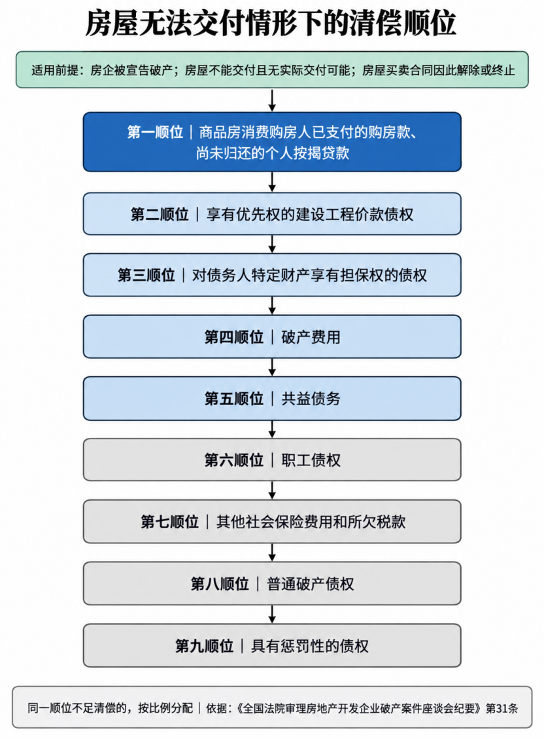
As shown in the figure above, when a real estate development enterprise is declared bankrupt, the houses cannot be delivered and there is no possibility of actual delivery, and the housing purchase contract is thus terminated or dissolved. In such cases, the purchase price paid by the consumers of commercial housing and the personal mortgage loans that have not been repaid rank first in the order of priority for repayment, and are superior to the priority right of construction project payment, as well as the security rights and bankruptcy expenses and common benefit debts. This is the special repayment rule established by the "Guidelines" for enterprises in bankruptcy, which breaks through the general sequence of priority repayment of security claims and bankruptcy expenses and common benefit debts in traditional bankruptcy law. Its legitimacy lies in the fact that the purchasing interests of consumers of commercial housing directly relate to basic living needs and survival rights, and should be given priority in value assessment over operating and financing claims; moreover, consumers of commercial housing are usually in an information asymmetry and weak position in risk identification and control in the housing transaction, so special protection is necessary.
Summary
In summary, the hierarchical system for protecting home buyers addresses the fundamental issue of "what to do if the house cannot be delivered"; however, whether the project can resume construction and continue with the development is the key to whether the house can be delivered, that is, "how can the house be delivered". The next part will interpret the continuation financing system in the "Agreement", including the initiation procedures for continuation construction, the repayment of financing debts, the division of existing and incremental values, and the applicable boundaries of prioritized negotiation.


-
Prev:Interpretation of the "Regulations on Protecting the Completion of Housing Projects" in the "Meeting Minutes of the National Court Conference on Handling Bankruptcy Cases of Real Estate Development Enterprises" (Part 2): Continuing Construction Financing and Practical Responses
-
Next:Business Case Notes | Determination of the Liability of the Executed Party in the Execution Procedure - Share Transfer Issues