








Dehe Case | Practical Guidance on the Entire Process for Minority Shareholders to Protect Their Rights Against Major Shareholders
01
Case background and core points of the case
(1) Basic Overview of the Case
The parties involved were minority shareholders holding 12% of the company's shares. They had significant differences in business decision-making with the majority shareholders who held a much larger share. The majority shareholders, leveraging their controlling position, dominated the board of directors, the board of supervisors, and the daily operations, nullifying the voting rights, right to information, and dividend rights of the minority shareholders, and refusing to cooperate with the normal duties of the shareholders, seriously infringing upon the legitimate shareholder rights of the minority shareholders.
(2) Core Legal Shareholding Advantage
Ownership stake of 12% > 10% threshold for legal requirements: Entitled to the right to request the convening of an interim shareholders' meeting;
Holding 12% > 1% legal threshold: Enjoy the right to submit temporary proposals to the shareholders' meeting;
This shareholding ratio is the optimal base shareholding ratio for small and medium-sized shareholders to achieve procedural checks and balances and initiate judicial remedies. It also meets the qualification requirements for initiating the complete legal protection procedures.
(III) Core Objectives of Case Handling
Act in accordance with the law and regulations to convene a temporary shareholders' meeting, and use the meeting's voting process to restrain the improper decisions made by major shareholders.
Standardize the entire process of the shareholders' meeting to ensure that the resolutions made are legal and valid.
File lawsuits to legally revoke, declare invalid or declare non-existent the resolutions of illegal or non-compliant shareholders' meetings or boards of directors;
Assist the parties in exercising the right of equity repurchase for dissenting shareholders under the conditions stipulated by law;
When the shareholders' conflicts reach an extreme level and the company is in a deadlock, a layered solution involving equity withdrawal, commercial mediation, and company dissolution should be formulated.
02
Legal basis (applicable legal provisions for case handling)
Article 113, Article 114, and Article 115 of the "Company Law of the People's Republic of China (2023 Revision)" (Rules for convening, presiding over, notifying, and handling temporary proposals at the shareholders' meeting)
Article 1, Article 3, Article 4, and Article 5 of the "Provisions of the Supreme People's Court on Several Issues Concerning the Application of the Company Law" (Judgment Rules for Non-Formation, Revocation, and Invalidity of Resolutions)
"Supreme People's Court's Provisions on Several Issues Concerning the Application of the Company Law (Rule on Mediation and Resolution of Shareholder Disputes)"
"Supreme People's Court's Provisions on Several Issues Concerning the Application of the Company Law (Rules for the Trial of Disputes over Company Dissolution)"
03
Practical Step 1: Legally convene a temporary shareholders' meeting (standard procedure for handling cases)
(1) The summoning process must strictly follow the legal sequence (no skipping levels, no violation of the case handling red line)
Priority 1: Submit a written application to the company's board of directors for convening an interim shareholders' meeting.
Document materials: "Written Application for Requesting the Company to Hold a Temporary Shareholders' Meeting"
Essential items: Shareholding ratio of the applicant, reasons for convening, proposed deliberation topics, and required response deadline;
Delivery method: EMS written mail + delivery via WeChat/Enterprise WeChat, etc. Keep the delivery receipt, signature record, and delivery screenshot.
Statutory period: The board will reply in writing within 10 days after receiving the application, indicating whether the meeting will be held or not.
Rank 2: The board of directors refuses to perform its duties and requests the Board of Supervisors to convene instead.
If the board fails to respond within the deadline or explicitly refuses to convene, immediately send the "Notice to the Supervisory Board to Convene an Emergency Shareholders' Meeting" to the supervisory board, thereby establishing evidence of the board's failure to act.
Rank 3: Directors and supervisors do not participate. Shareholders convene and chair the meeting themselves.
Only when both of the following two conditions are met can one convene by themselves:
Having held 10% or more of the equity for 90 consecutive days or more;
All the pre-procedures for urging the board of directors and the board of supervisors have been exhausted.
After the satisfaction is achieved, the temporary shareholders' meeting can be convened and presided over by our party's representatives themselves.
(II) Practical Operations of Meeting Notices and Temporary Proposals
Strict requirements for notification period: The interim shareholders' meeting must send out the meeting notice to all shareholders 15 days in advance, stating the meeting time, location, attendees, and all the deliberated matters, without any omissions or additions of topics afterwards.
Practical application of interim proposals: Our client submitted the interim proposal 10 days before the shareholders' meeting. The content could be drafted as follows: replacing incompetent senior executives, standardizing the financial management system, reviewing the annual profit distribution, stopping major shareholders' related-party transactions, clarifying the company's external investment matters, etc.
The company must forward the proposal to all shareholders within two days. It must not refuse to do so or raise the holding threshold for the proposal.
Prohibition in handling cases: The shareholders' meeting is strictly prohibited from deliberating on matters not listed in the notice; otherwise, the resolution will directly have significant flaws.
(III) On-site Practical Control of the Meeting (Key Points of Legal Counsel's Accompanying Work during the Case Handling Process)
Ensure that all the shareholder sign-in sheets, voting rights statistics sheets, meeting records, and voting signature documents are completed throughout the process.
Full audio and video recording, ensuring the accuracy of the attendance and voting processes.
Distinguish the voting ratio:
General business matters: The resolution takes effect upon the approval of more than half of the shareholders' voting rights.
Major matters such as capital increase and reduction, amendment of the articles of association, merger and division, dissolution, etc.: They shall take effect upon the approval by more than two-thirds of the voting rights.
04
Practical Step 2: Judicial Remedies for Defects in the Validity of Shareholders' Meeting Resolutions (Guidelines for Case Classification in Litigation)
(1) Precise application of three types of litigation (procedural classification criteria)
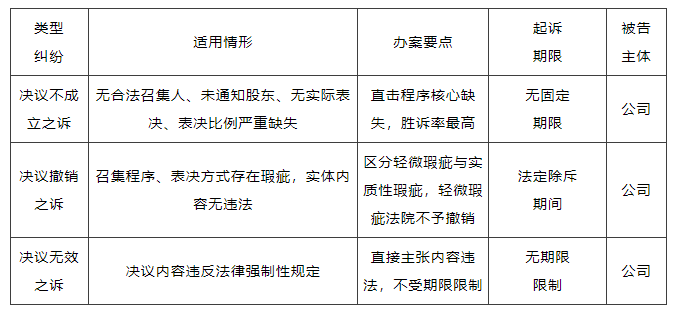
(II) Judicial Practice Standards (Risk Warning for Case Handling)
Judicial practice holds that any situation such as incorrect summoning sequence, insufficient notification time, or overstepping of authority in summoning shall be regarded as substantive procedural flaws and will not be tolerated. Please pay close attention to this.
Only minor errors in the text and flaws in the meeting procedures did not affect the substantive rights of the shareholders or the voting results. The court did not support the request for revocation.
05
Practical Step 3: Comprehensive Case Handling Plan for the Rights Protection of Minority Shareholders (Entity Level)
(1) Shareholder Right to Information Dispute (Preceding Legal Action for Rights Protection)
Purpose of the investigation: To obtain the company's financial ledgers, accounting vouchers, shareholder meeting records, and board resolutions, in order to collect evidence of the major shareholder's embezzlement of funds and concealment of profits.
Operation process: Submit a written request for review → Company denies the request → File a lawsuit for shareholders' right to know.
Case handling value: Provides comprehensive factual evidence for dividend litigation, repurchase litigation, and infringement accountability proceedings.
(2) Disputes over Share Repurchase by Dissenting Shareholders (Core Path for Shareholders to Exit)
Legal circumstances applicable for case handling
(1) Company mergers, divisions, and transfers of major core assets;
(2) The company has made profits for five consecutive years, but has refused to distribute the profits for the same period.
Standard case handling procedure
Voting against at the shareholders' meeting → Negotiating the acquisition price with the company within 60 days → If negotiations fail, filing a lawsuit for share repurchase within 90 days;
Practical flexibility in handling matters
Due to the大股东's malicious obstruction preventing them from attending the meeting, they have already submitted their opposition opinions in writing in advance. During the case handling process, it can be argued that the repurchase rules can be applied as a reference.
(III) Disputes over Company Profit Distribution
Case handling approach: Submit a dividend proposal through a temporary shareholders' meeting to form an effective dividend resolution;
Without any valid reason, refusing to distribute dividends for an extended period, directly filing a lawsuit for mandatory dividend distribution, and claiming to distribute the company's distributable profits in accordance with the law.
06
Step 4 of the practice: Ultimate case handling solution for the deadlock among company shareholders
(1) Prioritize mediation for resolution (Principle of Prior Commercial Case Handling)
The conflicts among shareholders have reached an extremely critical stage, and the company's governance has failed. Therefore, non-litigious methods of resolution should be given priority.
Coordinate the company's plan to repurchase the equity of minority shareholders.
Facilitate the acquisition of the subject equity by other shareholders and third parties;
Negotiate the company's capital reduction and business division to resolve the differences.
As the lead lawyer, one can act as the mediator to draft an equity settlement plan, thereby resolving the dispute at a low cost.
(2) Company Dissolution Litigation (Used with Caution, as a Last Resort in Case Handling)
Pleading grounds: The company is facing severe operational difficulties, the shareholders' meeting and the board of directors have been dysfunctional for a long time, and even after exhausting all internal remedies such as股权转让 (share transfer), repurchase, and mediation, the problem still cannot be resolved.
Key points for handling cases: During litigation, one can legally apply for evidence preservation and property preservation. It is strictly prohibited that such preservation actions interfere with the normal operation of the company.
Judicial stance: The court takes a cautious approach towards the company's dissolution, and will only grant such a ruling if there is a persistent and significant damage to the shareholders' rights.
07
List of Practical Work for Lawyers' Cases (Internal Execution Version)
Evidence retention list: All written correspondence, mailing receipts, delivery records, chat logs, and meeting documents should be uniformly filed and archived.
Program progress list: Proceed strictly in accordance with the timeline of "Board of Directors' notice - Supervisory Board's notice - Self-convening", and never operate beyond the hierarchical levels.
List of rights combination application: 10% convening right + 1% right to submit temporary proposals used simultaneously to comprehensively control the topics and procedures of the shareholders' meeting;
Litigation selection list: Priority: procedural checks and balances → Next: obtaining information rights → Then: implementing resolution-based remedies → Finally: share repurchase / dissolution and exit;
Parties' communication list: Inform in advance about the limitations of the 12% equity voting, and clearly define the strategy of uniting with other shareholders to jointly safeguard their rights and interests in the litigation process.
08
Case Handling Risk Warning
Without completing the necessary advance notice procedures and directly holding a shareholders' meeting on one's own, the resolutions made will be highly likely to be deemed invalid, and the rights protection will completely fail.
The temporary shareholders' meeting arbitrarily added unannounced topics, which constitutes a major procedural violation and is at risk of being revoked.
The 12% minority shareholders' individual shares are insufficient to veto the company's major decisions, and they cannot make an absolute guarantee of victory to the parties involved.
For equity repurchase and company dissolution lawsuits, the burden of proof is high. It is necessary to collect and fix all relevant financial, operational and decision-making evidence in full before the lawsuit is filed.
09
Conclusion (Case Processing Summary)
The case where minority shareholders holding 12% of the shares oppose the infringement of rights by the major shareholder falls under typical commercial cases in corporate disputes that are highly procedural and have clear legal boundaries. During the case handling process, it is essential to strictly adhere to legal procedures, distinguish the levels of rights protection, and accurately select the litigation path. Firstly, internal governance balance can be achieved through a temporary shareholders' meeting, and then, based on the shareholders' right to know, illegal evidence can be fixed. According to the degree of conflict in the case, the following solutions can be applied successively: resolution relief, share repurchase, commercial mediation, and company dissolution. This approach not only maximally safeguards the property rights and shareholder participation rights of minority shareholders, but also takes into account the stability of commercial transactions, achieving a unified effect between legal theory and practical case handling.


